
Witness Intimidation Charges in Idaho
Witness intimidation charges often show up in domestic violence cases because the alleged victim is also the key witness. The State will frequently file this charge when it believes someone tried to pressure, scare, harass, or discourage a witness from reporting, cooperating, or testifying.
In Idaho, the main witness intimidation statute is Idaho Code section 18-2604, Intimidating a Witness.
Boise DV Defense represents clients in Boise and across Ada County, including Meridian, Garden City, and Eagle.
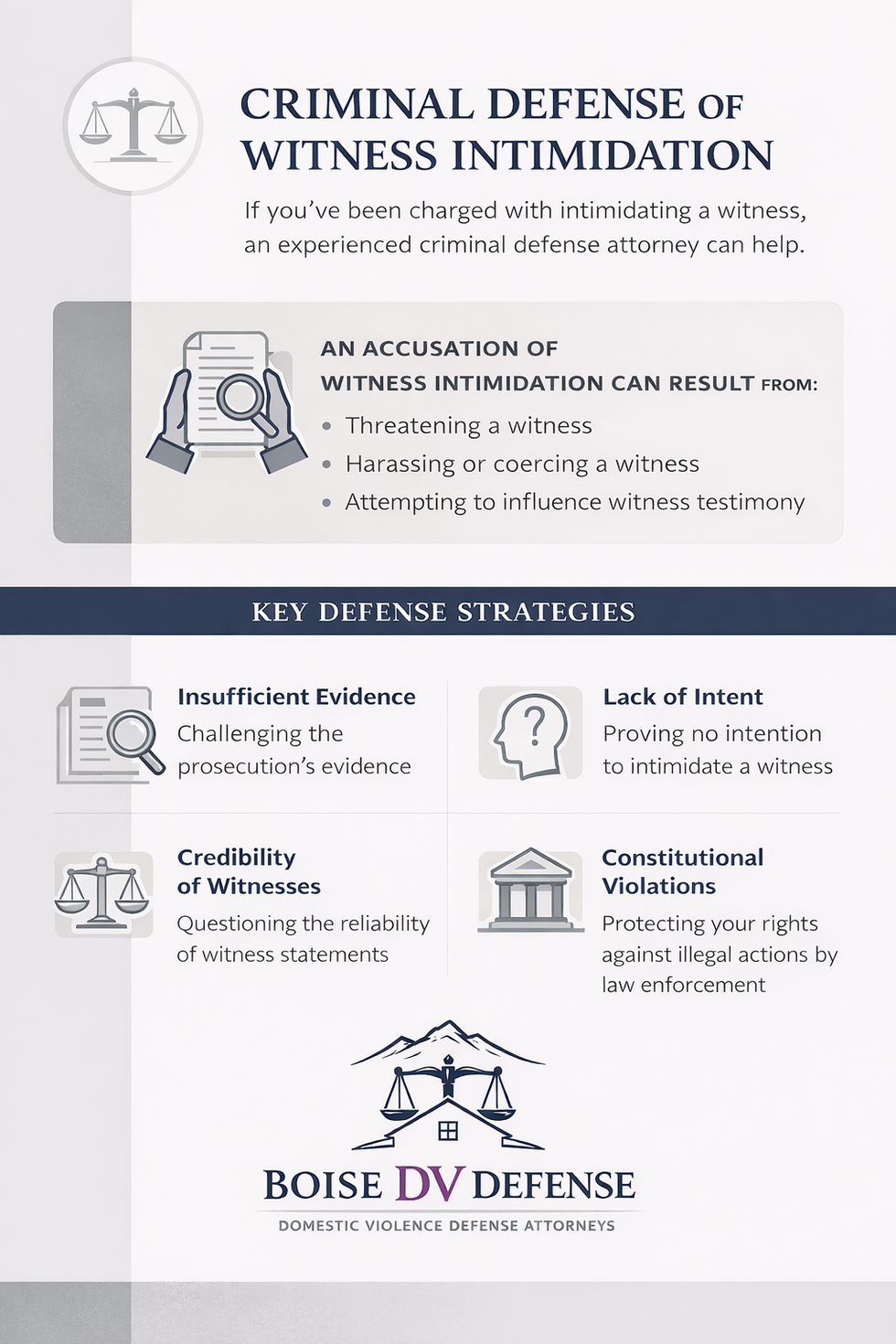
What counts as witness intimidation under Idaho law
Idaho Code section 18-2604 broadly criminalizes conduct that, by direct or indirect force or threats to a person or property, willfully intimidates, influences, impedes, deters, threatens, harasses, obstructs, or prevents a witness, or someone the defendant believes may be a witness.
Two common “buckets” prosecutors use
Interfering with testimony or cooperation
This includes alleged conduct aimed at stopping someone from testifying “freely, fully and truthfully.”
Retaliation or harassment after testimony
The statute also covers intimidation, threats, or harassment because someone testified, or because the defendant believes they testified.
Civil case versus criminal case
Idaho's statute treats civil proceedings as misdemeanors and criminal proceedings or juvenile evidentiary hearings as felonies. In domestic violence prosecutions, the allegation usually involves a criminal proceeding, which is why this charge is commonly filed as a felony.
What the State must prove
The Idaho Criminal Jury Instructions for intimidating a witness track the statute and are commonly used to frame what the prosecutor must establish at trial.
Two points from Idaho appellate case law matter in real cases:
-
The State does not have to prove the intimidation succeeded. Idaho appellate courts have held it is not necessary to prove the defendant's conduct actually affected testimony or actually prevented the witness from testifying.
-
A case does not always have to be already filed to support a felony charge. Idaho courts have interpreted the criminal proceeding language broadly, including situations involving anticipated or future proceedings, depending on the facts and proof.
Penalties and sentencing exposure
If charged as a misdemeanor
When the allegation is tied to a civil proceeding, the statute classifies it as a misdemeanor.
If a misdemeanor statute does not specify a penalty, Idaho's default misdemeanor penalty can apply, up to 6 months in jail and up to a 1,000 dollar fine, or both.
If charged as a felony
When the allegation is tied to a criminal proceeding or juvenile evidentiary hearing, Idaho Code section 18-2604 classifies it as a felony.
If the specific felony statute does not list a separate punishment, Idaho's default felony penalty can apply, up to 5 years in prison and up to a 50,000 dollar fine, or both.
Multiple counts are common
Prosecutors sometimes file a separate count for each contact, call, message, or incident, especially when there are multiple communications from jail or repeated contacts over days. Idaho appellate opinions reflect that intimidating a witness counts are often charged alongside the underlying case.
Other consequences beyond the sentence
Witness intimidation allegations can cause immediate damage even before trial.
Bond and release conditions get harsher
Courts may tighten release conditions, increase bail, restrict phone and messaging access, or impose stricter no-contact boundaries.
A no-contact order violation risk increases
In DV cases, the same conduct alleged as intimidation may also be argued as a no-contact order violation, creating additional exposure.
Your underlying case gets harder to defend
Even if the intimidation charge is ultimately reduced or dismissed, the allegation can influence charging decisions, plea posture, and sentencing arguments in the underlying DV case.
Employment and licensing fallout
A felony charge can trigger job loss, professional licensing issues, and background check consequences, especially if the case involves court orders and alleged threats.
How these charges arise in Boise domestic violence cases
Most witness intimidation filings in Ada County DV cases grow out of one of these scenarios:
-
Calls or messages asking the alleged victim to drop charges or not show up
-
Messages that imply consequences if the person testifies
-
Repeated contacts that become harassment in the State's narrative
-
Third-party contact, meaning a friend or family member reaching out on the defendant's behalf
The prosecution does not need the witness to actually change their behavior to pursue the charge, which is why early intervention matters.
Defenses that often matter
Every case turns on the exact words, the context, and what the State can prove about intent. Common defense angles include:
-
No willful intimidation or threat: anger, venting, or messy relationship communication is not automatically a felony
-
Protected, non-threatening communication: communication that does not threaten or harass may not meet the statute's requirements
-
Identity and proof issues: who actually sent the message, who had access to the phone, and what the full thread shows
-
Witness status and proceeding issues: whether the person was a witness or believed to be a witness under the statute, and how the State proves that belief in context
What to do if you are under investigation or already charged
-
Stop all direct and indirect contact immediately. Do not use friends or family to “smooth it over.”
-
Do not discuss the facts on jail phones or recorded lines. Those recordings are routinely used to build intimidation allegations.
-
Get counsel involved early. Witness intimidation cases are won and lost on the record: full message threads, timestamps, call recordings, and context.
Talk to a Boise witness intimidation defense attorney
If you are facing witness intimidation accusations in Boise, Meridian, Garden City, Eagle, or anywhere in Ada County, get legal advice tailored to your facts before you make the situation worse.