How Domestic Violence Cases Work in Ada County, Idaho
Domestic violence cases in Ada County move fast, involve immediate court orders that affect your home and family, and often include mandatory evaluation and treatment requirements even on a first offense. If you are arrested in Boise, Meridian, Eagle, or Garden City, you should assume two things right away.
First, the court will treat safety and separation as the default until a judge says otherwise. Second, the prosecution will build the case around the initial 911 call, on scene statements, photos, and medical records, not around what either person “wants” later.
This page explains the typical path of a domestic violence case in Ada County, the local Domestic Violence Court program, and the treatment and compliance issues that routinely decide outcomes.
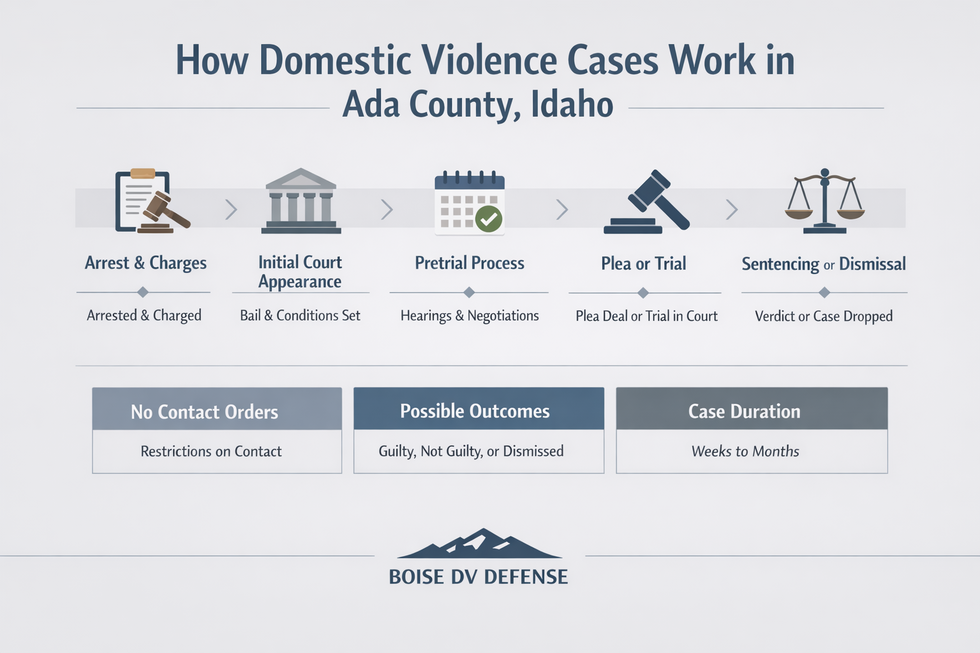
Step 1: The arrest and the first 24 hours
Most domestic violence cases start the same way:
-
A 911 call or third-party report
-
Police separate the parties and take statements
-
Officers document injuries, marks, damaged property, and the scene
-
Someone is arrested, often based on what officers believe happened in the moment
In Idaho, most “domestic violence” charges are domestic assault or domestic battery, which depend on the underlying definitions of assault and battery and whether the parties qualify as household members.
Step 2: No contact orders happen early and they matter
In Ada County, it is common for a no contact order to be issued immediately after arrest as a condition of release or by court rule. This order can bar all contact, including text messages, calls, and third-party contact, even if the other person wants contact.
Violating a no contact order is its own charge under Idaho Code section 18-920.
Two practical points:
-
“We both agreed” is not a defense. The order is the court's order.
-
If you need contact for children, housing logistics, or civil case issues, your lawyer should address it early through proper court procedure, not workarounds.
Step 3: The first court dates: initial appearance and arraignment
The early hearings are where release conditions are set, counsel is addressed, and the case gets its first scheduling order.
Typical early issues include:
-
Bail or bond and release conditions
-
No contact order terms
-
Firearm restrictions as a condition of release
-
Whether the case stays misdemeanor in magistrate court or proceeds as a felony
If your case is charged as a felony domestic battery with traumatic injury, or if the State alleges enhancement based on prior convictions, the legal details matter. Idaho appellate courts regularly address how enhancements apply and when they can be charged.
Step 4: Ada County Domestic Violence Court and why it changes the game
Ada County has a dedicated Domestic Violence Court model and related programming that focuses on structured accountability, compliance monitoring, and coordinated handling of family-related issues. The Idaho State Bar has described it as a collaboration between the justice system and community partners, and it historically used a one family, one judge approach in its family violence model.
Separate from the big-picture model, Ada County also publishes participant-facing materials for its misdemeanor DV court program, which lays out expectations and compliance requirements.
What that means for you in real life:
-
Your deadlines and compliance tracking can be tighter than a standard misdemeanor track.
-
“Doing nothing and waiting” usually backfires.
-
Early mitigation, evaluation planning, and treatment choices often determine whether you get a workable probation outcome or a punitive one.
Step 5: Evaluation and treatment requirements are not optional in practice
Idaho's domestic violence statute authorizes evaluations and court-ordered counseling or treatment, and it ties treatment standards to the Idaho Council on Domestic Violence and Victim Assistance.
On top of that, Idaho Criminal Rule 33.3 sets detailed requirements for evaluations in domestic assault, domestic battery, and attempted strangulation cases, including risk assessment components and required collateral information.
Ada County also maintains an approved treatment provider list used in domestic violence cases.
The strategic issue is not whether evaluation and treatment will come up. It will. The issue is how to handle it in a way that:
-
avoids wasting money on the wrong type of evaluation,
-
prevents treatment recommendations that do not match the facts, and
-
supports a resolution that keeps you out of jail and protects your record as much as possible.
Step 6: Pretrial phase: discovery, motions, and leverage
After the initial hearings, the case shifts into evidence and litigation.
Key parts of this phase:
-
Discovery review: body cam, 911 audio, photos, medical records, witness statements
-
Motions: suppress statements, challenge searches, challenge admissibility, enforce procedural rules
-
Negotiations: reduction, dismissal, or structured probation resolutions tied to mitigation
Idaho domestic violence convictions are frequently litigated on the details of what was proven and how the trial court handled it, including in misdemeanor cases.
Step 7: Resolution options in Ada County
Most cases end one of four ways:
Plea agreement
Many cases resolve with a negotiated plea. The terms matter, especially around probation length, jail time, treatment requirements, and whether the plea is structured to reduce long-term consequences.
Trial
Trials in domestic violence cases often come down to credibility, the reliability of early statements, and whether the State can prove each required element beyond a reasonable doubt.
Sentencing and probation
If there is a conviction, the practical focus becomes probation terms, compliance, and treatment completion. In Ada County, the domestic violence court structure and local compliance expectations often shape what probation looks like.
Dismissal
An outright dismissal of a case is rare, but this can happen if evidence does not support the charge, key witnesses are unavailable, constitutional issues exist, or the State reassesses the case.
Step 8: Protection orders and why they create a second front
Many Ada County domestic violence situations include civil protection orders in addition to the criminal case. Violating a civil protection order can be charged separately under Idaho Code section 39-6312.
Criminal cases and civil protection orders move on different tracks with different rules. Treat them as separate problems that must be handled together.
What you should do immediately if you were arrested in Ada County
-
Do not contact the protected person if a no contact order exists, not even “to apologize.”
-
Preserve evidence now: screenshots, messages, call logs, photos of injuries, and names of witnesses.
-
Get your body cam and 911 evidence early through counsel.
-
Start planning mitigation the right way, which may include evaluation planning consistent with Idaho Criminal Rule 33.3 and Ada County provider requirements.
Talk to a Boise domestic violence defense lawyer
Boise DV Defense represents clients in Ada County domestic violence cases, including domestic battery, attempted strangulation, and violations of court orders. Early decisions in these cases routinely determine whether you end up with a manageable resolution or a long probation grind with escalating penalties. Give us a call to see how we can help with your case.