
Civil Protection Orders in Ada County Idaho: A Defense Attorney Primer
Civil protection orders are fast-moving, high-impact court orders. In Idaho, they are civil orders issued under the Domestic Violence Crime Prevention Act, but violating them can lead to criminal charges. If you treat a protection order hearing like a casual family dispute, you can lose your housing, your firearm rights, and your contact with your kids in a single hearing.
This page explains how civil protection orders start, how they are served, what happens at the hearing, and the practical steps to ask for an order or fight one in Ada County.
What a civil protection order is in Idaho
A civil protection order is a court order that can restrict contact, remove someone from a residence, set temporary custody terms, and impose other safety-related restrictions when the court finds an immediate and present danger of domestic violence. The process is governed primarily by Idaho Code Title 39, Chapter 63.
What counts as domestic violence for a protection order
Idaho's definition for this civil process focuses on physical injury, sexual abuse, forced imprisonment, or threats of those acts involving certain relationships, including family or household members and certain dating relationships.
That definition matters. If the allegations do not fit the statute, the court should deny the order.
Where Ada County civil protection orders are filed
Protection order petitions are filed in the Magistrate Division of the District Court. Idaho law allows filing in the county where the respondent lives, where the petitioner lives, or where the petitioner is temporarily staying.
In Ada County, the Clerk and Court Assistance resources direct people to use Idaho Guide and File for e-filing, or to print and file in person at the courthouse.
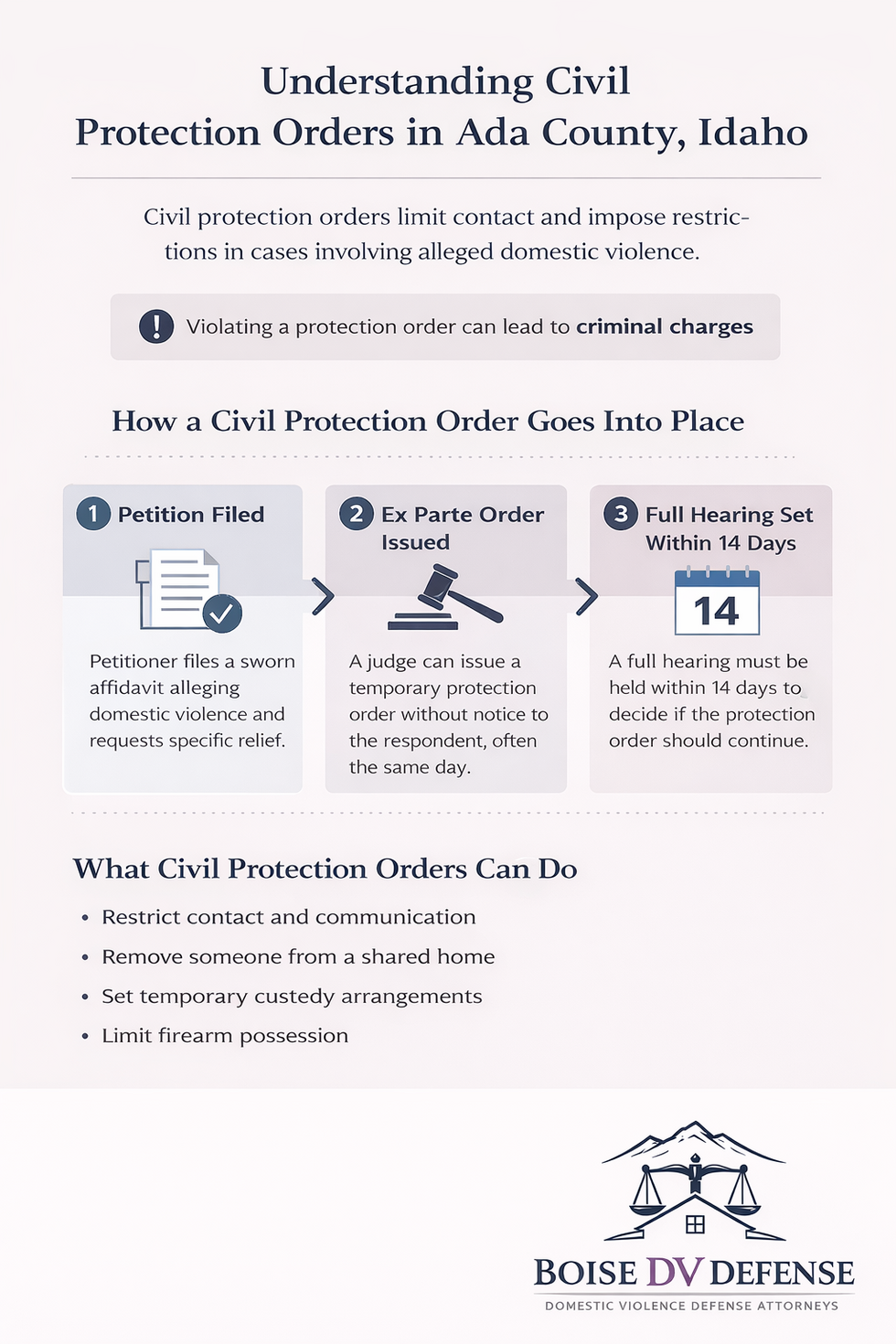
How a civil protection order goes into place
Step 1: The petition and sworn affidavit are filed
The case begins with a petition supported by a sworn affidavit alleging domestic violence and requesting specific relief. The statute also requires certain disclosures, especially when custody issues exist.
Step 2: The judge may issue an ex parte temporary order
If the papers allege irreparable injury could result without immediate protection, the court can issue an ex parte temporary protection order without prior notice to the respondent, typically the same day or the next judicial day.
The temporary order can include restraints on contact, exclusion from a shared residence, and temporary child-related restraints, among other relief.
Duration: The ex parte temporary order generally lasts up to 14 days, and a full hearing must be set within 14 days from issuance.
If the order severely impacts housing or parenting: The respondent can move to shorten the timeline for the hearing, with notice requirements.
Step 3: The respondent must be served
Orders and related papers generally must be personally served. In many cases, law enforcement serves the paperwork unless the petitioner chooses private service at the petitioner's expense.
Service rules matter because enforcement and criminal exposure for violations often hinge on notice and service.
What happens at the 14-day hearing
Idaho law requires a hearing within 14 days of filing to decide whether the requested protection order should be entered.
Continuances for counsel
If one side has counsel and the other does not, the court must allow a continuance if requested so the unrepresented party can obtain counsel.
Time limits are real
Under the Idaho Rules of Family Law Procedure, evidentiary time for civil protection order actions is generally limited to 30 minutes per side, unless the judge allows more.
That means you must prioritize the few facts that actually prove or disprove the statutory elements.
Evidence rules and the practical “hearsay” problem
In protection order hearings, the evidence rules can be more flexible unless a party files a timely motion requesting strict compliance with the Idaho Rules of Evidence. For civil protection order actions, that motion must be filed no later than 2 days before the 14-day hearing and is heard at the start of the hearing.
This is a strategic decision. Strict evidence rules can help a respondent exclude unreliable hearsay. It can also backfire if the court finds good cause to deny the motion based on fairness concerns.
Common types of relief the court can order
At the full hearing, the court can order a range of relief, including restraining orders, exclusion from a residence, and temporary custody terms in appropriate cases.
How to ask for a civil protection order in Ada County
If you are the petitioner, the court expects specifics and credibility.
Practical filing checklist
-
Write the affidavit like you expect cross-examination. Dates, locations, what happened, who saw it, what you did afterward.
-
Attach what matters. Photos, medical records, police reports, text messages, call logs, voicemail exports.
-
Ask for relief you can justify. No contact is different than being removed from a home. Custody requests require statutory disclosures.
-
Use Guide and File or file in person. Ada County directs petitioners to Idaho Guide and File for online completion and e-filing, or paper filing through the courthouse.
Hearing preparation
-
Bring a one-page timeline and a short list of the exact orders you want.
-
Bring 3 copies of exhibits if you are not e-filing exhibits in advance.
-
Plan your 30 minutes. You do not have time to tell your entire relationship story.
How to fight or defeat a civil protection order at the hearing
If you are the respondent, the biggest mistake is showing up unprepared and trying to “explain the relationship.” The question is narrower: did the petitioner prove the statutory basis for an order.
Step 1: Read the petition like a charging document
Look for:
-
Allegations that do not meet the statutory definition of domestic violence.
-
Vague claims with no dates, no specifics, no corroboration.
-
Requests that are overbroad, especially around housing and parenting.
Step 2: Build a focused defense theory
Common defense themes that work in this setting:
-
Statutory mismatch: the alleged conduct is not domestic violence as defined for this chapter.
-
Credibility and reliability: inconsistent statements, motive in custody or divorce context, missing details that should exist.
-
Context that changes the meaning: for example, alleged threats that are actually mutual argument without a true threat of bodily injury.
-
Overreach: even if some order is justified, the requested relief is broader than needed.
Step 3: Decide whether to file an evidence motion
If the petitioner's case relies heavily on secondhand statements, consider a motion for strict compliance with the Idaho Rules of Evidence, filed no later than 2 days before the hearing, knowing the court can deny it for good cause.
Step 4: Prepare exhibits and witnesses
-
Exhibits: texts, emails, video, social media, medical records, location data.
-
Witnesses: the one or two people who actually matter, not a parade of character witnesses.
-
Cross-examination: prepare tight questions that expose uncertainty, exaggeration, and inconsistencies.
Step 5: Ask for realistic outcomes
At the hearing, your best result may be:
-
Denial of the protection order entirely, or
-
A narrower order with clear terms, limited duration, and no unnecessary custody restrictions.
How civil protection orders are modified or terminated
Orders can be changed, ended, or otherwise modified.
Modification or termination standard
By statute, the court may modify the terms of an existing protection order upon application, with notice to all parties and after a hearing.
If the order is terminated or modified before expiration, the clerk must transmit the changed order to law enforcement, and law enforcement must enter it into the system.
Practical reasons people seek modification
-
Parenting exchanges are unworkable as written
-
The no-contact terms conflict with a separate family law custody plan
-
The parties need limited contact for child-related logistics
-
Relocation, employment, or housing changes
Enforcement and the criminal risk of violating an order
Violating a civil protection order after notice can be prosecuted as a misdemeanor, with exposure up to 1 year in jail and a fine up to $5,000 under Idaho Code § 39-6312.
If you have an order against you, do not “test” it, do not rely on verbal permission, and do not assume a third party message is safe. Get the order modified the right way.
When to get a defense attorney involved
You should treat a civil protection order like a high-stakes case when any of the following are in play:
-
You could be excluded from your home
-
Your parenting time could be cut off
-
You own firearms or your job involves weapons
-
There is a parallel criminal DV investigation
-
You have prior DV-related history
At Boise DV Defense, we approach protection order cases the same way we approach criminal defense: fast triage, evidence-first strategy, and hearing-ready preparation within the 14-day timeline. Give us a call today to talk to one of our criminal defense attorneys and see how we can help at your civil protection order hearing.