
Conditions of Release in Ada County Domestic Violence Cases
If you are arrested for a domestic violence related offense in Ada County, the first fight is usually not the trial. It is getting you released with workable conditions, and keeping you compliant so you do not pick up new charges or get your bond revoked.
Judges in Ada County regularly impose strict release conditions in domestic violence cases because they are focused on safety risks and repeat allegations. These conditions often change the day to day realities of housing, parenting time, firearms, and communication.
This page explains the release conditions we most commonly see in Ada County domestic violence cases, how they are imposed, how they can be modified, and how to stay compliant.
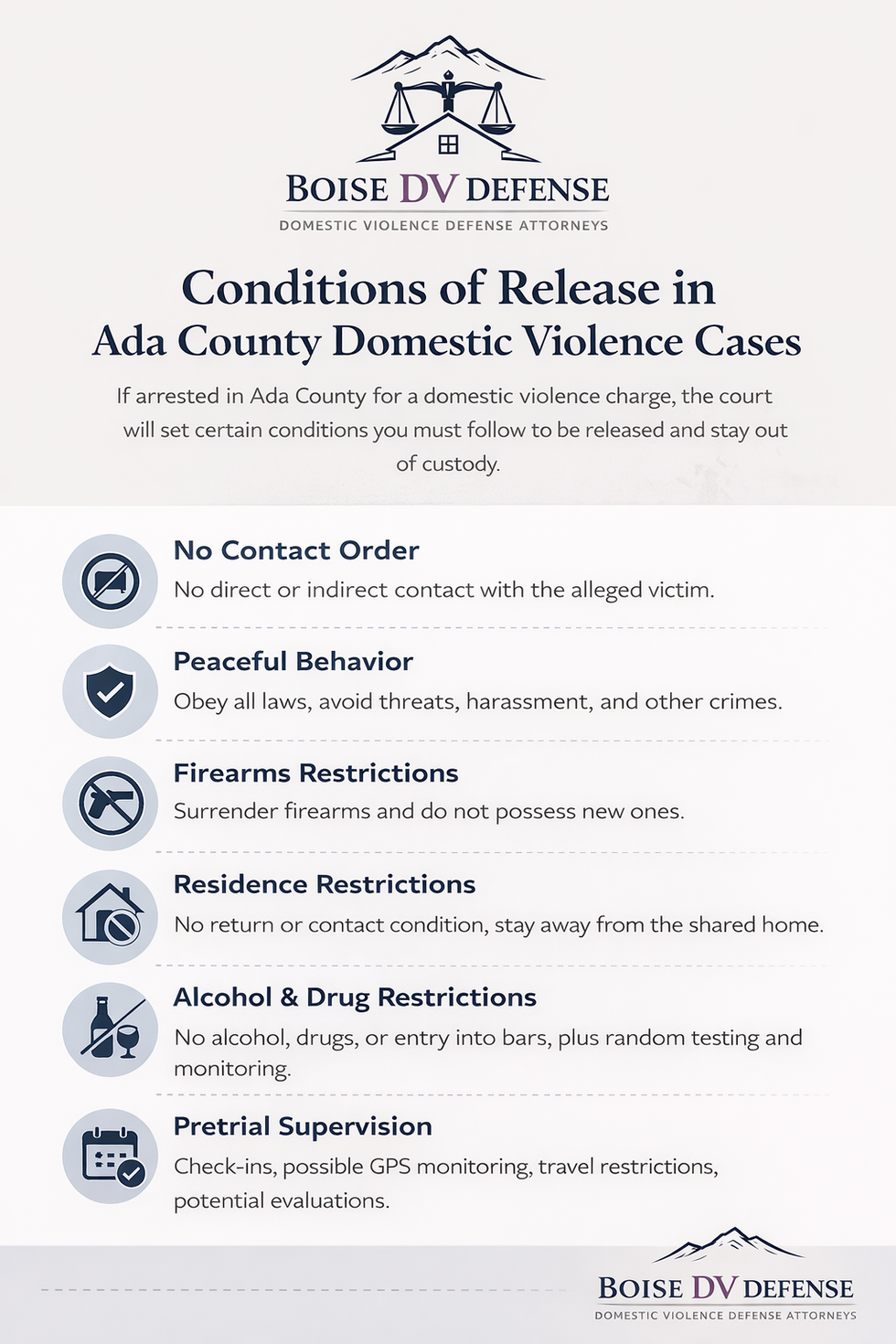
What “conditions of release” are
Idaho courts have broad authority to set bail or release you on your own recognizance and to impose conditions of release. The court considers risk factors such as community ties, prior history, the current allegations, and the likelihood of violations if released without restrictions.
Conditions of release are court orders. Violating them can lead to arrest, new charges, bond revocation, and much worse bargaining posture in your underlying domestic violence case.
When conditions are imposed in Ada County
In most domestic violence arrests, conditions are set quickly, usually at or near the first appearance before a magistrate. The judge sets an order of release that may include a bond amount, whether the bond is cash or surety, and specific conditions you must follow. Idaho Criminal Rule 46 governs this process statewide.
In Ada County, domestic violence cases frequently intersect with the Ada County Domestic Violence Court, which is designed for accountability, structured oversight, and referrals to treatment resources.
The release conditions most commonly imposed in domestic violence cases
Every case is different, but these are the conditions we see most often in Ada County domestic violence related charges.
No contact order or no contact condition
This is the most common condition.
A no contact order can be issued by the court in the criminal case, and violations can be charged as a separate crime. Idaho law recognizes no contact orders issued by courts or by Idaho criminal rule, and criminalizes contact in violation of the order when one is in place.
Typical terms include:
-
No direct contact: calls, texts, emails, letters
-
No indirect contact: messages through friends or family, social media comments, likes, tagging, and third party outreach
-
Stay away distances, often including home, work, school, and other routine locations
Peaceful behavior and no new law violations
Judges typically order you to obey all laws, avoid threats and harassment, and maintain the peace. If there is any second incident, even a minor one, it can become the reason the court tightens conditions or revokes bond.
Firearms restrictions and surrender
In domestic violence cases, courts often impose conditions restricting possession of firearms and sometimes require surrender. If this applies to you, do not treat it casually. You need to understand exactly what the order requires and get proof of compliance.
Residence restrictions and move out orders
The court may order you not to return to a shared residence, even if you pay the rent or mortgage. Sometimes the order is structured as “no return” or “stay away,” sometimes it is written as a broader no contact condition that effectively forces separation.
Child exchange and parenting related conditions
Judges may prohibit contact with the protected person while still allowing limited child related arrangements, usually with strict boundaries such as:
-
Exchanges at a neutral location
-
Exchanges through a third party
-
Exchange timing rules
-
No discussion beyond logistics
If the order is unclear, that is a compliance trap. Get it clarified immediately.
Alcohol and controlled substance restrictions
Common conditions include:
-
No alcohol
-
No controlled substances without a valid prescription
-
Random testing
-
No entry into bars or liquor establishments in some cases
Pretrial services, check ins, and monitoring
Depending on the assessed risk and the allegations, the court may require:
-
Regular check ins
-
Travel restrictions
-
Curfew
-
Electronic monitoring or GPS
Treatment and evaluation requirements
It is common in Ada County domestic violence case management for defendants to be referred toward evaluations and treatment resources.
Even when treatment is not ordered as a release condition, it often becomes a major factor later in negotiations and sentencing. We often recommend that our clients complete a domestic violence evaluation or enroll in treatment quickly to help mitigate the charges.
How conditions are modified in Ada County
Conditions are not always permanent. They can be modified, but it is not automatic and it should be done the right way.
The usual ways conditions change
-
Defense motion to modify conditions
This is the standard route when conditions are unworkable or unnecessary. The court can adjust conditions, reduce bail, or revise restrictions based on updated information. -
Stipulated modification
Sometimes the defense and prosecution agree to a change and present it to the judge. The judge still makes the final decision. -
Court initiated change after a violation or concern
If the court thinks you are not taking conditions seriously, expect tighter terms, not looser ones.
What judges typically want to see before loosening conditions
-
Clean compliance record
-
Verified stable housing plan
-
Verified employment, schooling, or caregiving responsibilities
-
Documented treatment steps already started
-
A clear safety plan for any requested contact, especially child related contact
-
A credible explanation for why the change is necessary
Practical steps to stay compliant and protect your case
This is where people ruin cases. Not with guilt but with sloppy compliance.
Get the exact written order and read it line by line
Do not rely on memory, jail paperwork summaries, or what someone else told you. Conditions vary by judge and by case.
Assume indirect contact counts as contact
If you think “I did not call them” is a defense, you are setting yourself up. Third party messages, social media engagement, and passing information through friends commonly lead to violations.
Build a compliance plan the same day you are released
-
Save the order to your phone and print a copy
-
Put court dates, check in schedules, and testing schedules into a calendar
-
Set reminders for curfews and check ins
-
Identify prohibited locations and avoid them entirely
Use one safe channel for child logistics
If the order allows limited child related logistics, keep it narrow and structured. Keep messages short, factual, and focused on the child. Do not argue, explain, accuse, or negotiate.
Document compliance
Keep proof of:
-
Firearm surrender or storage compliance, if required
-
Class enrollment and attendance
-
Treatment intake appointments
-
Testing results and check ins
-
Housing arrangements
When something is unclear, do not guess
If the order is ambiguous, treat it as a stop sign. Contact your attorney immediately and ask for clarification or a modification request. Guessing is how violation cases happen.
Why involving a defense attorney early matters
In Ada County domestic violence cases, release conditions can determine whether you keep your job, where you live, whether you can see your kids, and whether your case stabilizes or spirals.
Early defense work focuses on:
-
Arguing for the least restrictive conditions under Idaho Criminal Rule 46 factors
-
Challenging unnecessary no contact scope and unworkable housing terms
-
Building a structured modification request that the judge can grant
-
Keeping you compliant so you do not hand the prosecution new leverage
If you want us to evaluate your specific release order and identify the highest risk compliance issues, we can do that quickly. The goal is simple: keep you out, keep you compliant, and keep the case defensible.