
Video Voyeurism Charges in Idaho: Definitions, Penalties, and What's at Stake
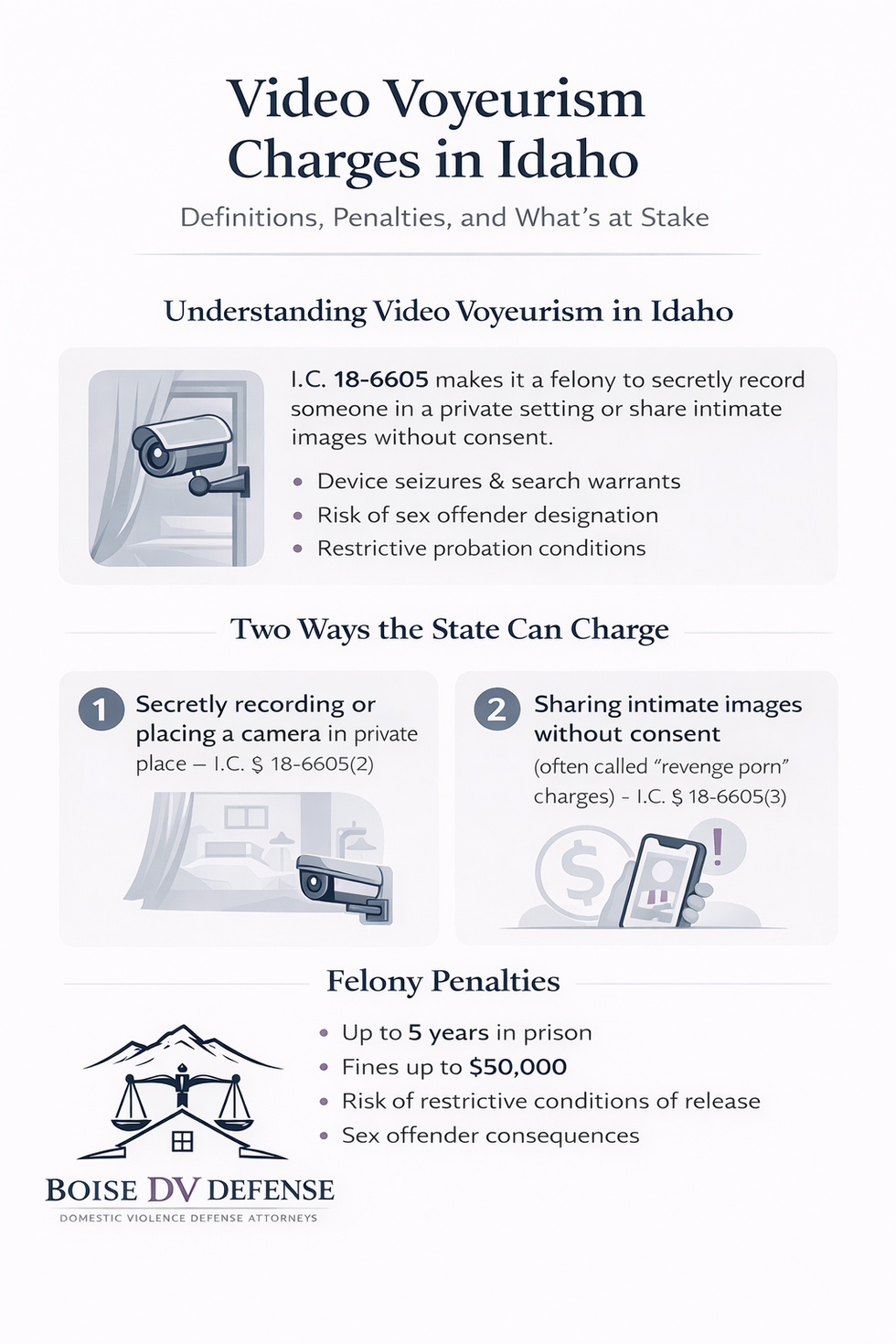
If police or prosecutors accuse you of “video voyeurism,” they are alleging more than “taking a picture.” Idaho's video voyeurism statute, I.C. 18-6605, is a felony and it can trigger jail or prison exposure, sex-offender-related consequences, device seizures, restrictive probation conditions, and long-term reputational damage—especially in domestic or relationship-driven allegations.
Boise DV Defense represents people across Boise and the Treasure Valley, including Meridian, Garden City, and Eagle, facing privacy-based sex-crime accusations, including video voyeurism.
What Idaho Law Means by “Video Voyeurism”
Idaho's current video voyeurism statute is Idaho Code § 18-6605.
Key definitions prosecutors rely on
The statute contains detailed definitions that often drive the entire case:
-
“Imaging device” is broadly defined as any instrument capable of recording, storing, viewing, or transmitting images.
-
“Intimate areas” includes nude genitals, nude pubic area, nude buttocks, or nude female nipple.
-
“Place where a person has a reasonable expectation of privacy” includes places where someone would reasonably expect privacy to undress or engage in sexual activity, places reasonably safe from hostile surveillance, and even certain public places when an imaging device is used to see through or under clothing.
-
“Disseminate,” “publish,” and “sell” are defined broadly and can include posting, displaying, circulating, or making an image accessible to the public.
These definitions matter because many cases turn on location, consent, and what the device was used to capture.
The Two Main Ways Idaho Charges Video Voyeurism
1) Secret recording or placement of a camera or phone in a private place - I.C. § 18-6605(2)
A person can be charged if—with a sexual-purpose intent—they use, install, or permit the use/installation of an imaging device in a place where someone has a reasonable expectation of privacy without that person's knowledge or consent.
This is the typical “hidden camera,” “phone under the door,” “bathroom or bedroom” fact pattern.
Phones are quickly seized and searched in any Ada County investigation and these cases can escalate into major felony prosecutions when law enforcement believes a device contains voyeurism evidence.
2) Sharing intimate images: often called “revenge porn” fact patterns - I.C. § 18-6605(3)
Idaho also criminalizes intentionally disseminating, publishing, or selling an image of an identifiable person whose intimate areas are exposed when done with intent to annoy, harass, humiliate, or degrade, plus additional “knew or should have known” privacy and consent elements.
This subsection is commonly charged where there's a breakup, domestic conflict, jealousy, or retaliation allegations and then one party to the breakup sends nudes to others or posts them publicly online.
Penalties: Video Voyeurism Is a Felony in Idaho
Idaho Code states a violation of § 18-6605 “is a felony.”
When a statute declares an offense a felony but does not list a specific sentencing range inside that statute, Idaho's general felony penalty provision applies: up to 5 years in prison and/or up to a $50,000 fine.
Real-world sentencing exposure can still be severe
Even when the “statutory max” is five years, Idaho courts can impose meaningful prison terms and strict supervision conditions in practice. Appellate opinions reflect outcomes like unified multi-year sentences and retained jurisdiction “rider” structures in video voyeurism cases.
Other Consequences Beyond Jail or Prison
1) Sex offender registration risk in certain situations
Video voyeurism can create sex offender registration consequences when specific conditions are met, including scenarios involving minors or repeat convictions as referenced in Idaho's registration statute—litigated in Idaho appellate courts.
2) Sex-offender-style supervision—even in related cases
Even when a case resolves in a way that avoids a formal sex offense conviction, the underlying allegations can still drive sex-offender caseload supervision and treatment requirements in some probation contexts, depending on the case posture and the Department of Correction's classification decisions. Being placed on the sex-offender caseload means heightened restrictions for having a cell phone, being able to access the internet, or being able to be in a relationship.
3) Search warrants, device seizure, and digital forensics
These cases routinely involve seizure of phones, computers, cloud accounts, and social media. Courts litigate suppression issues - what police could seize, when, and why - and those rulings can decide the case.
4) Protective orders no-contact restrictions and family fallout
In domestic-related allegations, it is common to see no-contact orders, civil protection orders, custody disputes, employment discipline, and reputational harm—regardless of the eventual outcome in criminal court.
What the State Must Prove
Video voyeurism cases frequently rise or fall on intent and knowledge—not just whether an image exists.
An Idaho Court of Appeals decision analyzing earlier versions of the voyeurism statute illustrates the point: the court focused closely on the required mental state and what the State had to prove about how images were obtained and what the defendant knew. State v. Yarber, No. 42418, 2015 WL 9259888 (Idaho Ct. App. Dec. 18, 2015).
Similarly, another Idaho case addressing probable cause issues in a video voyeurism charge underscores that courts can dismiss when the State's theory and the evidence don't match—especially on intent-based elements. State v. McLellan, 154 Idaho 77 (Ct. App. 2013).
Common Defense Themes in Video Voyeurism Cases
Every case is fact-specific, but these issues come up repeatedly:
-
No reasonable expectation of privacy: location matters; the statute's definition is detailed and litigable.
-
Consent: or lack of proof beyond a reasonable doubt
-
No sexual-purpose intent - for § 18-6605(2)
-
No intent to harass/humiliate/degrade and no proof of the “knew or should have known” privacy elements for § 18-6605(3)
-
Identity / access defenses: who controlled the phone account, cloud backups, logins, or social media
-
Suppression issues: illegal search/seizure of devices, scope of warrants, chain of custody
If You're Being Investigated in Boise or Ada County
Video voyeurism investigations move fast. Police often seek interviews early and try to secure devices before data can be deleted. Once charges are filed, conditions of release can be strict, and the case can immediately affect housing, employment, and parenting.
Boise DV Defense helps clients by:
-
Intervening early with investigators when appropriate
-
Controlling the narrative before charging decisions harden
-
Litigating suppression and probable cause issues
-
Preparing trial-ready defenses when the State overreaches
-
Negotiating outcomes designed to minimize long-term damage
Talk to a Boise Video Voyeurism Defense Attorney
If you've been arrested, cited, served with a summons, or you believe you're under investigation for video voyeurism in Boise, Meridian, Garden City, Eagle, or anywhere in Ada County, get counsel involved immediately.