Ada County Domestic Violence FAQs
If you were arrested or investigated for a domestic violence related offense in Ada County, you are dealing with fast-moving deadlines, strict no contact rules, and consequences that can follow you for years. This page answers the questions we hear most often from people charged in Boise, Meridian, Garden City, and Eagle, with answers grounded in Idaho statutes, Idaho criminal rules, and Idaho case law.
Boise DV Defense represents clients across the Treasure Valley from 10114 W Overland Rd, Boise, ID 83709. Call 208-392-1964.
What counts as domestic violence in Idaho
In Idaho, “domestic violence” is not a single charge. It is typically an assault or battery allegation where the alleged victim qualifies as a “household member” under Idaho law. Idaho Code section 18-918 ties common domestic violence charges to the assault and battery definitions in Idaho Code sections 18-901 and 18-903.
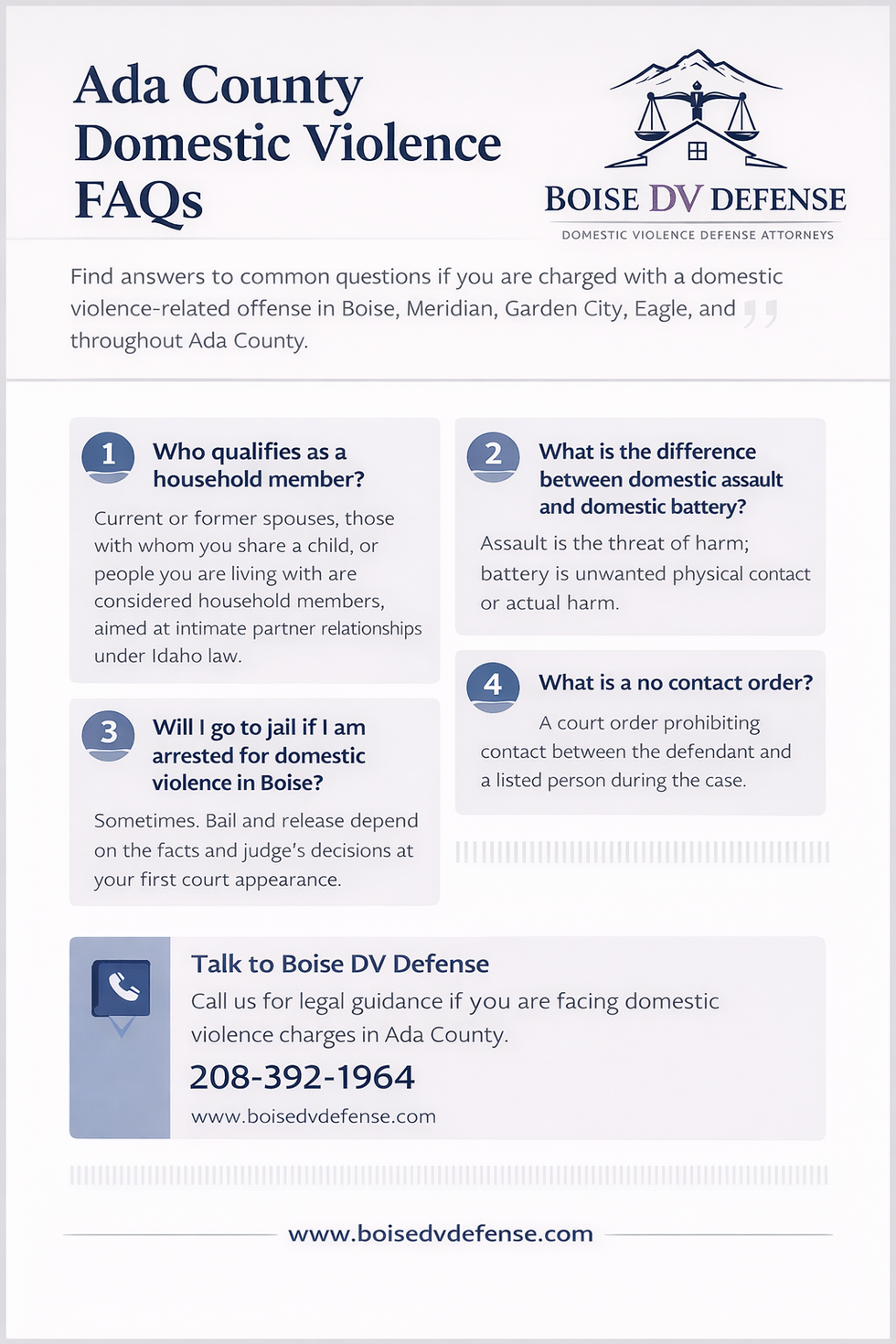
FAQ 1: Who qualifies as a household member
Under Idaho Code section 18-918, a household member generally means a spouse, former spouse, a person with whom you have a child in common, or a person with whom you are cohabiting.
Important limitation: the Idaho Supreme Court has held the household member definition in 18-918 is aimed at intimate partner type relationships and does not automatically include a child living with a parent for purposes of felony domestic battery or attempted strangulation under these statutes.
FAQ 2: What is the difference between domestic assault and domestic battery
Assault is commonly charged when the allegation is an attempted injury or a threat that creates fear of imminent violence. Battery is commonly charged when there is an alleged unwanted touching, striking, use of force, or bodily harm. So, assault is scaring or threatening a household member, battery is actually touching or harming one.
Arrest, booking, and first court date in Ada County
FAQ 3: Will I go to jail if I am arrested for domestic violence in Boise
Sometimes. Idaho law and local practice often treat domestic violence calls as high-risk because of alleged repeat contact and escalation concerns. Whether you book and release, bond out, or stay in custody depends on facts, criminal history, and conditions the judge sets.
FAQ 4: What happens at arraignment in Ada County
Arraignment is where you are formally advised of the charge, you enter a plea, and the court addresses conditions of release. In many domestic violence cases, the court will issue or keep in place a no contact order.
No contact orders in Ada County
FAQ 5: What is a no contact order
A no contact order is a criminal court order that forbids the defendant from contacting a listed person. In Idaho, no contact orders are tied to Idaho Code section 18-920 and are governed procedurally by Idaho Criminal Rule 46.2.
FAQ 6: Can the protected person contact me if there is a no contact order
A common point of confusion is that the order restricts the defendant's conduct. Even if the protected person reaches out, you can still be the one who violates the order if you respond or meet up. The safest move is no response and immediate legal advice.
FAQ 7: How do I modify or remove a no contact order in Ada County
You generally need a court order modifying it. Idaho Criminal Rule 46.2 addresses how no contact orders must be issued and served, and it provides a process for requesting a hearing in certain situations, including a short seven-day deadline for a modification motion when the defendant was not present when the NCO was issued.
FAQ 8: What happens if I violate a no contact order
Violation of a no contact order is its own criminal charge under Idaho Code section 18-920. Do not treat it as a technicality. Violations can stack into a felony charge, and we see that often in these types of cases where prosecutors count each different call or text as a separate violation of the no contact order.
FAQ 9: Does the court have to follow specific form requirements for a no contact order
Yes. Idaho Criminal Rule 46.2 requires no contact orders issued under Idaho Code section 18-920 to be on the Supreme Court form and properly served or signed.
Also, Idaho appellate decisions have addressed enforceability problems when courts do not have jurisdiction to modify older no contact provisions the way they attempted to do.
Civil protection orders versus no contact orders
FAQ 10: What is a civil protection order and how is it different from a no contact order
A civil protection order is usually issued under Title 39, Chapter 63, Idaho Code, based on a petition filed in a civil case. A no contact order is issued in the criminal case. They are different cases, different rules, and different consequences.
FAQ 11: What are the penalties for violating a civil protection order
Violation of a protection order issued under Title 39, Chapter 63 can be prosecuted under Idaho Code section 39-6312 when the restrained person had notice of the order. A violation of a civil protection order is its own criminal charge, but the potential consequences are different than with the violation of a criminal no contact order.
Common Ada County DV charges and penalty exposure
FAQ 12: What is misdemeanor domestic battery in Idaho
Under Idaho Code section 18-918, a household member who commits a battery against another household member without traumatic injury is generally charged as misdemeanor domestic battery. The statute also provides enhanced penalties based on prior domestic violence convictions within specified time windows.
FAQ 13: What makes domestic battery a felony in Idaho
Felony domestic battery under Idaho Code section 18-918 is tied to a battery that results in “traumatic injury,” which the statute defines broadly as an external or internal injury caused by force, even if minor. In practice, any marking left from a domestic battery counts as a "traumatic injury" under the statute. We see these cases charged as felonies where the injury is as small as red marks, small scratches, or slight bruising.
FAQ 14: Does the state have to prove I intended the specific injury
Not always. Idaho appellate decisions interpreting felony domestic battery have focused on what the statute requires the state to prove, including the willful commission of the battery and the required traumatic injury element. This means that if you pushed past your spouse to get out of a room during an argument, and your spouse bumps against the door and has a small bump on their elbow, this can count as "traumatic injury" and could be charged as a felony.
FAQ 15: What is attempted strangulation in Idaho
Attempted strangulation is a felony under Idaho Code section 18-923 and covers willfully and unlawfully choking or attempting to strangle a household member or a person with whom the defendant has or had a dating relationship.
FAQ 16: Does attempted strangulation require injuries or loss of consciousness
The statute focuses on the act and the attempt to impede breathing or circulation, not on whether the person passed out. In real cases, the allegation can be charged even where injuries are minimal, and your defense strategy must focus on the statutory elements. We often see attempted strangulation charges pop up with no visible injuries. This means that you can be charged with a felony under this code based on a witness statement alone. The prosecution does not need any independent medical or expert evidence to corroborate the testimony for charges.
Evidence questions that come up constantly
FAQ 17: If the alleged victim recants, will the prosecutor dismiss the case
Not automatically. In Ada County, as elsewhere, prosecutors decide whether to proceed based on available evidence, not solely on whether the reporting party wants to go forward.
FAQ 18: Can the state proceed without the alleged victim testifying
Sometimes. Prosecutors may try to use body camera, 911 recordings, photos, medical records, or witness statements. Whether those are admissible and sufficient depends on rules of evidence and constitutional confrontation issues.
FAQ 19: Can I use self-defense in a domestic violence case
Self-defense is fact-driven and depends on what the state can prove and what your evidence shows. In practice, this is one of the most important areas to develop early, including identifying third-party witnesses, recordings, and injury documentation.
FAQ 20: What if I was falsely accused during a breakup or custody dispute
It happens. The practical response is not arguing your way out at the scene or over text. It is preserving evidence, stopping all prohibited contact, and building a defense around verifiable facts and statutory elements.
Guns, jobs, and other life consequences
FAQ 21: Will a domestic violence charge affect my gun rights
It can. Federal law imposes firearm restrictions for certain qualifying protection orders and for convictions that qualify as misdemeanor crimes of domestic violence.
This is an area where a plea that seems minor can have permanent consequences. You need counsel who checks both Idaho outcomes and federal collateral consequences before any plea.
FAQ 22: Will this show up on background checks
Yes. Arrests, charges, and court records often appear in background checks. Even a withheld judgment can create real-world consequences depending on the context.
Ada County Domestic Violence Court and treatment resources
FAQ 23: What is Ada County Domestic Violence Court
Ada County has a specialized Domestic Violence Court model and provides resources including evaluator referrals, treatment referrals, and process guidance.
FAQ 24: Will I be ordered to treatment or classes
It is common for courts to order evaluations, counseling, or batterer intervention style programming as a condition of release or probation, especially for cases routed through domestic violence court resources.
What you should do immediately if you were charged in Ada County
-
Do not contact the protected person directly or indirectly if any no contact order is in place.
-
Stop posting about the case and stop texting about the incident.
-
Write down a timeline while it is fresh, then stop discussing it with anyone but your attorney.
-
Preserve evidence: screenshots, call logs, injury photos, witness names, security video.
-
Get counsel early, before the first meaningful court date and before you give statements.
Talk to Boise DV Defense
If you are facing domestic violence related charges in Ada County, your strategy needs to match Idaho's statutes, local court practice, and the specific charge elements. Give us a call today to see how we can help in your case.