Violating a Court Order in an Idaho Domestic Violence Case
Civil Protection Orders vs. No-Contact Orders in Ada County
If you have a civil protection order (CPO) or a no-contact order (NCO) entered against you in Boise or elsewhere in the Treasure Valley, a “small” mistake can turn into a new criminal charge, a jail booking, and worse bond conditions. These orders are not interchangeable. They come from different courts/processes, use different standards, and are enforced differently—but both can carry serious penalties.
This page explains: (1) where each order comes from, (2) what the key definitions are, (3) what conduct is prohibited, and (4) what punishments and consequences you face for violations in Idaho.
Quick definitions
What counts as “domestic violence” for protection-order purposes?
Idaho's civil protection order statutes define “domestic violence” to include physical injury, sexual abuse, forced imprisonment, or threats of those acts involving a household member.
Who qualifies as a “family or household member”?
The protection-order definitions also cover categories like spouses/former spouses, relatives by blood/adoption/marriage, people who reside/have resided together, and people with a child in common (among others).
These definitions matter because a civil protection order generally requires both:
-
a qualifying relationship, and
-
qualifying “domestic violence” conduct.
Civil Protection Orders (CPOs): what they are and where they come from
A CPO is a civil case—separate from any criminal case
A civil protection order is sought by the protected person (the “petitioner”) in a civil court process under Idaho's domestic violence crime prevention chapter.
Basis for a CPO: “immediate and present danger”
At the hearing stage, the court may grant relief for up to one year, and sometimes longer through renewal procedures, upon a showing of immediate and present danger of domestic violence.
What a CPO can order
A CPO can include broad restrictions and safety provisions, such as:
-
no contact,
-
stay-away distances,
-
exclusion from a residence,
-
temporary custody provisions,
-
other protective terms the court finds necessary.
Important: A CPO can exist even if no criminal charge is filed.
No-Contact Orders (NCOs): what they are and where they come from
An NCO is a criminal-court order: often a condition of release
A no-contact order is typically issued in a criminal case and is often tied to conditions of release, pretrial supervision, or probation terms.
Idaho's NCO statute applies when a person is charged with or convicted of certain victim related offenses and the court finds an NCO appropriate.
NCOs can be issued by statute or by Idaho Criminal Rule
Idaho Criminal Rule 46.2 governs the form, service, and procedures to request hearings and modifications/termination in many situations.
Who can modify/terminate an NCO?
In practice, NCOs are judge-controlled in the criminal case. Even if the protected person wants contact, the order generally remains in effect until the court changes it.
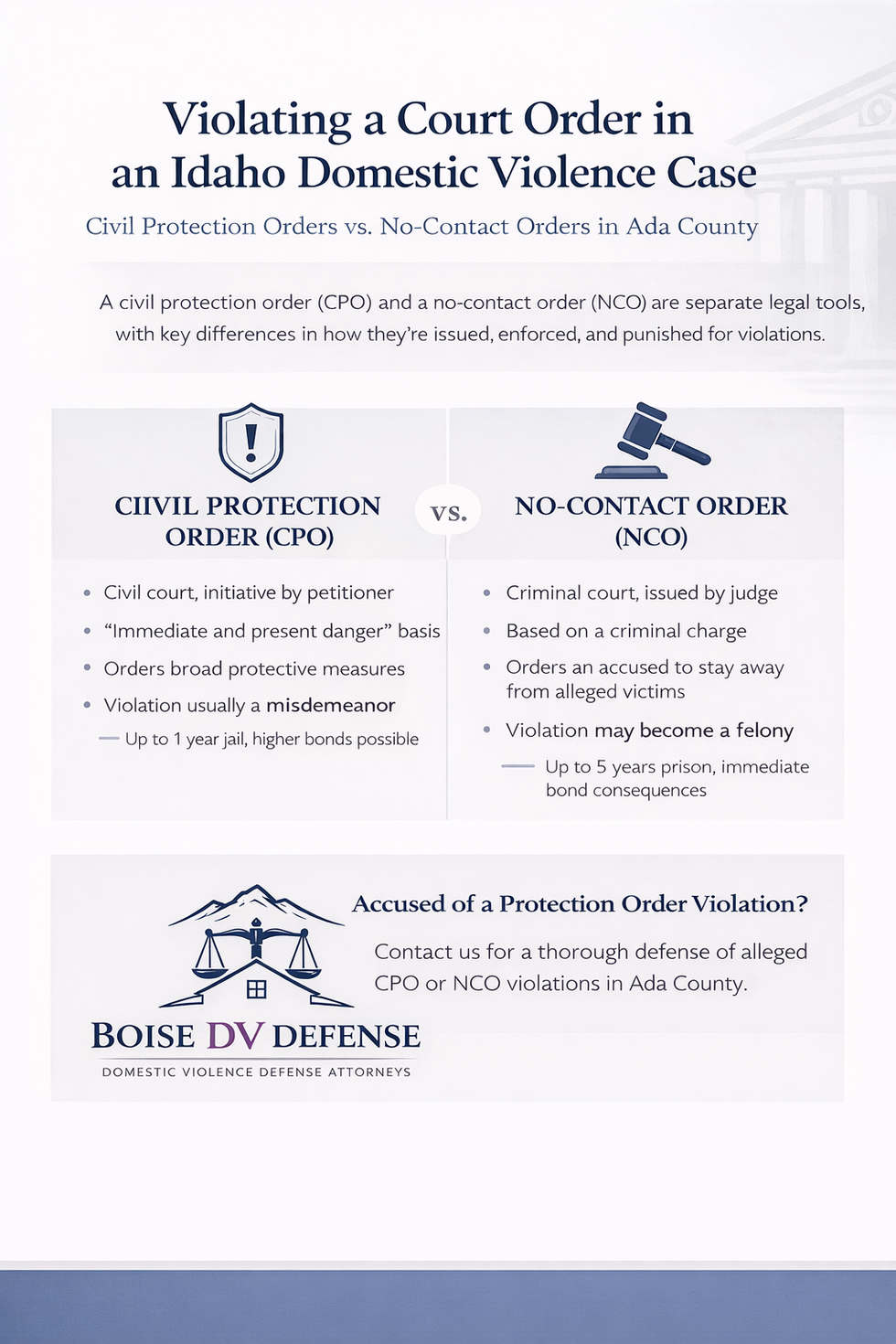
Major differences between CPOs and NCOs
1) The “case type”
-
CPO: civil case, initiated by the petitioner.
-
NCO: criminal case condition, issued by the criminal court.
2) The “why”
-
CPO: based on domestic violence definitions + danger findings.
-
NCO: based on criminal charges or allegations.
3) What happens if you violate
-
CPO violation: typically charged as a misdemeanor under the protection-order penalties statute.
-
NCO violation: charged under Idaho Code § 18-920, with escalating exposure for repeat violations.
4) The “real-world trap”
People most often violate orders through:
-
“just one text,”
-
responding to the protected person's outreach,
-
social media messages,
-
having a friend pass a message,
-
showing up somewhere you “didn't think counted,”
-
contact during child-exchange confusion.
If the order prohibits direct or indirect contact, those situations can still be violations.
Punishments for violating a Civil Protection Order
If a protection order has been granted and you had notice, a violation is generally a misdemeanor punishable by:
-
up to 1 year in jail, and
-
up to a $5,000 fine.
Law enforcement may arrest without a warrant when there is probable cause to believe the order was violated.
Punishments for violating a No-Contact Order
First NCO violation
A violation of a no-contact order is generally punishable by:
-
up to 1 year in county jail, and/or
-
up to a $1,000 fine.
Repeat NCO violations can become a felony
If you plead guilty to or are found guilty of an NCO violation and you have two prior NCO-violation convictions within five years of the first conviction, the new violation can be charged as a felony, punishable by:
-
up to 5 years in prison, and/or
-
up to a $5,000 fine.
Bond consequences are immediate—and often brutal
Idaho's statute also provides that:
-
no bond shall be set for the NCO-violation charge until you're brought before the court, and
-
the violation may result in increased bond, bond modification, or bond revocation on the underlying criminal case.
This is why an NCO violation can turn a manageable DV case into a custody + jail + bond crisis very quickly.
“But they contacted me first” is not a defense to the charge
This is one of the most common misconceptions. If you are the restrained party, the safest assumption is:
You are responsible for compliance even if the other person invites contact.
If there's a legitimate reason contact needs to happen - child logistics, property exchange, counseling arrangements - that is typically handled by:
-
seeking a court modification, or
-
using structured exceptions written into the order, or
-
using third-party or supervised exchange options consistent with the order.
Other consequences beyond jail and fines
Violations frequently trigger consequences that don't show up on the statute's penalty line, including:
-
new criminal charges that can be used by prosecutors to argue you're a higher risk,
-
stricter conditions of release: GPS, pretrial supervision, alcohol conditions, etc.,
-
immigration consequences: case-specific—get advice immediately if you are not a U.S. citizen,
-
employment/licensing fallout when background checks show repeated violations,
-
custody/parenting-time complications in parallel family court disputes, especially if the order includes stay-away or child-related terms.
What to do if you're accused of violating a CPO or NCO in Ada County
-
Stop all contact immediately.
-
Preserve evidence: screenshots, call logs, location data, witness info. Do not edit messages.
-
Do not “explain it” to police without counsel—these cases often turn on small details.
-
If you're already charged, assume the court will scrutinize compliance and bond risk first.
Talk to a Boise protection-order / no-contact-order defense lawyer
Boise DV Defense represents people accused of domestic violence-related offenses and court-order violations in Ada County and throughout the Treasure Valley.