
First Appearance on a Domestic Violence Charge in Ada County, Idaho
If you are arrested for a domestic violence related charge in Ada County, the first appearance is the court's first formal opportunity to address three things that immediately affect your life:
-
Whether you get released, and on what conditions
-
Whether the court imposes a no contact order
-
What the case path looks like next, based on whether it is a misdemeanor or felony
This hearing moves fast. The decisions made here often set the tone for everything that follows. If you want the best chance at a reasonable bond and workable release conditions, you involve a defense attorney immediately, not after you have been sitting in jail for days.
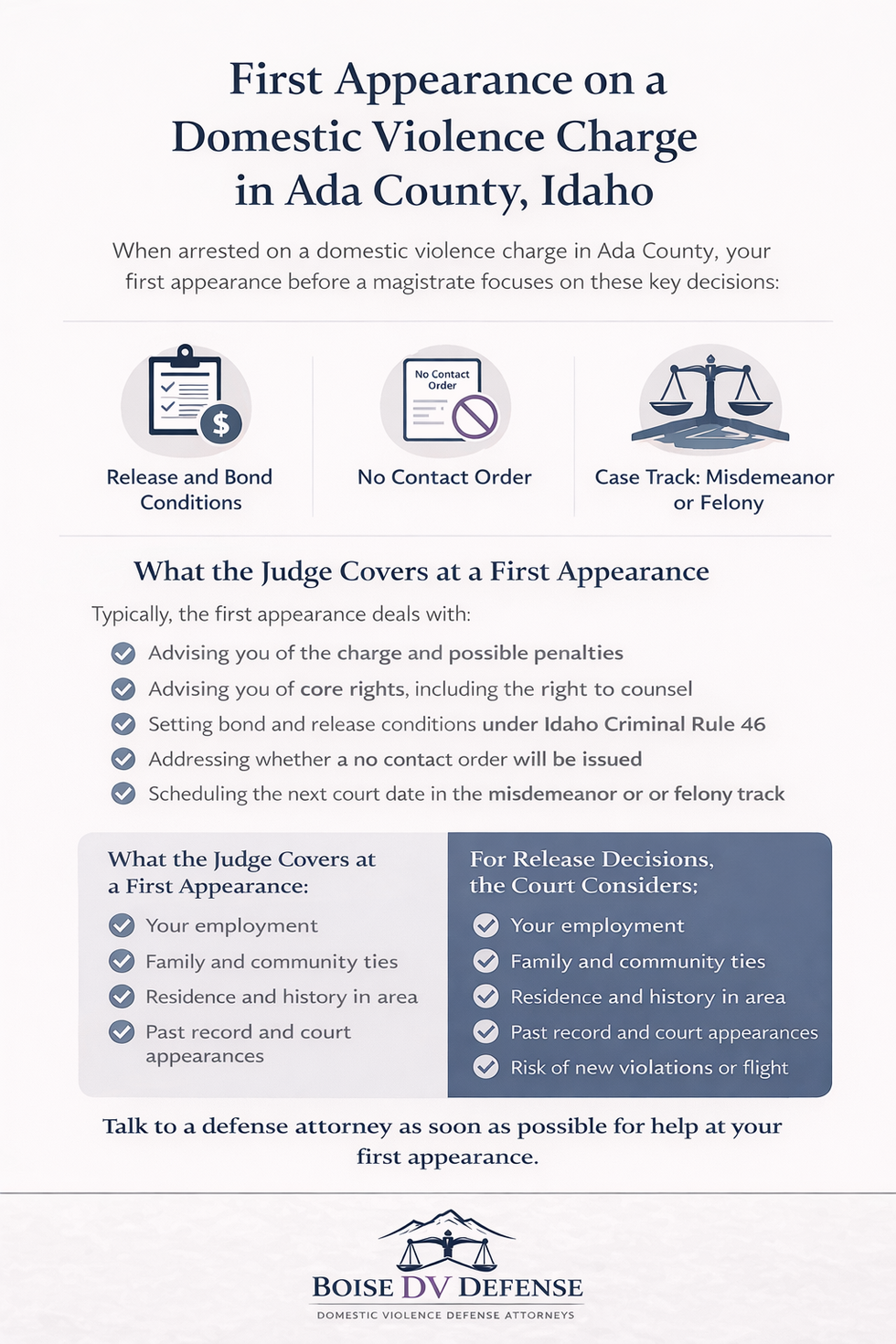
What the judge covers at a first appearance
While details vary by courtroom and judge, the first appearance in domestic violence cases is typically focused on:
-
Advising you of the charge and possible penalties
-
Advising you of core rights, including the right to counsel
-
Setting bond, or confirming release on recognizance when appropriate
-
Setting conditions of release under Idaho Criminal Rule 46
-
Addressing whether a no contact order will be entered
-
Scheduling the next court date in the misdemeanor or felony track
Bond and release conditions under Idaho Criminal Rule 46
The baseline rule
In non capital cases, the court must admit a defendant to bail or release the defendant on recognizance before a guilty plea or verdict.
How the court decides bond amount and conditions
Rule 46 lists specific factors the judge may consider when deciding whether you should be released, the amount of bail, and what conditions should apply. These include employment and financial condition, family ties, residence history, character and reputation, the seriousness of the charge and likely penalties, prior record, whether you have appeared in past cases, risk of new violations, community ties, and results of a pretrial risk assessment tool approved by the Idaho Supreme Court.
What conditions can be imposed
If the court releases you on bail or recognizance, the judge may impose reasonable terms, conditions, and prohibitions the court finds necessary.
In domestic violence cases, common conditions include:
-
No contact order and stay away provisions
-
Alcohol restrictions
-
Firearm restrictions
-
Curfew and geographic restrictions
-
Pretrial supervision and check ins
-
Counseling, evaluation, or classes
-
Electronic monitoring or GPS in higher risk cases
If the court imposes an electronic or GPS restricted area condition, Rule 46 requires written notice that intentionally leaving the restricted area, except for emergency medical care, can be prosecuted as escape.
Cash, surety, and property options
Rule 46 also limits how courts can structure bail. The court cannot require cash only bail and cannot set different bail amounts depending on whether you post cash, surety bond, or property bond.
No contact orders at first appearance
Why no contact orders show up in DV cases
In many domestic violence related charges, the court considers a no contact order immediately to prevent contact with the alleged victim or other protected persons while the case is pending.
Rule 46 expressly connects no contact orders to Idaho Code section 18-920 and requires that when no contact is ordered under that statute, the no contact order must be issued consistent with the standards in Rule 46.2.
What Rule 46.2 requires
Rule 46.2 requires that no contact orders issued under Idaho Code section 18-920 must be in writing on the Supreme Court form, and they must be served on or signed by the defendant.
If you were not present when the order was initially issued, you may request a hearing on the order. That request must be filed within seven days of service, and the court must hold a hearing within fourteen days of the filing and provide notice to the protected person and the parties.
Modification or termination requests
Rule 46.2 also allows the protected person to request modification or termination by filing a written and signed request with the clerk, and the court must provide a hearing within fourteen days and give notice to the protected person and the parties.
Misdemeanor versus felony: how the case path changes after first appearance
The first appearance is the release conditions hearing for both tracks. The difference is what happens next.
If the DV charge is a misdemeanor
Step 1: Arraignment and bond conditions discussion
This is where the court confirms the charge, addresses counsel, and sets or reviews bond and conditions under Rule 46.
In DV cases, the court frequently addresses a no contact order at the same time.
Step 2: Pretrial conference
The case moves into the pretrial phase, where deadlines, discovery, and negotiations typically begin. This is also where defense counsel can start pushing for changes to release conditions when facts support it, such as modifying overly broad restrictions.
Step 3: Sentencing or trial
If the case resolves, it proceeds to sentencing. If not, it proceeds to trial.
If the DV charge is a felony
Step 1: Arraignment and bond conditions discussion
Same immediate focus as a misdemeanor: release, bond amount, and Rule 46 conditions, with no contact order issues often addressed immediately.
Step 2: Preliminary hearing
In most felony DV cases, the next major event is the preliminary hearing in magistrate court, where the state must show probable cause to move the case forward.
Step 3: District court arraignment and entry of plea
If bound over, the case proceeds to district court for arraignment and plea entry. If the magistrate court finds that there is no probable cause for the case, the case gets dismissed at the preliminary hearing and you do not make it to district court.
Step 4: Pretrial conference
The case then moves into district court pretrial litigation, including motions, negotiations, and trial preparation.
Step 5: Sentencing or trial
If resolved, sentencing follows. If not, the case proceeds to trial.
Why hiring a defense attorney immediately matters
Bond and release conditions are not a formality in domestic violence cases. They are the structure you live under while your case is pending. The wrong conditions can:
-
Keep you in jail longer than necessary
-
Block you from returning home, seeing your children, or accessing your property
-
Create technical violations that turn into new criminal charges
-
Put you at a disadvantage in preparing mitigation and defense
Early representation is how you put real information in front of the judge that Rule 46 specifically allows the court to consider, including employment stability, family ties, residence history, community ties, and the feasibility of tailored restrictions instead of blanket ones.
Just as important, early counsel lets you start building the case immediately: preserving evidence, identifying witnesses, addressing treatment and evaluation questions strategically, and positioning you to pursue the best resolution.
Talk with Boise DV Defense before your first appearance, or as soon as possible after
Boise DV Defense represents people accused of domestic violence related offenses across Ada County, including Boise, Meridian, Garden City, and Eagle.
Call 208-392-1964
Boise DV Defense, 10114 W Overland Rd, Boise, ID 83709
If you are in custody, the window to influence bond and conditions is short. The earlier we are involved, the more control you have over the outcome at the first appearance.