If you have a domestic violence related case in Ada County, the fastest way to get yourself in deeper trouble is to treat a court order like a suggestion. Judges do not appreciate that. This page is a practical overview of three connected topics:
-
How court order modifications work
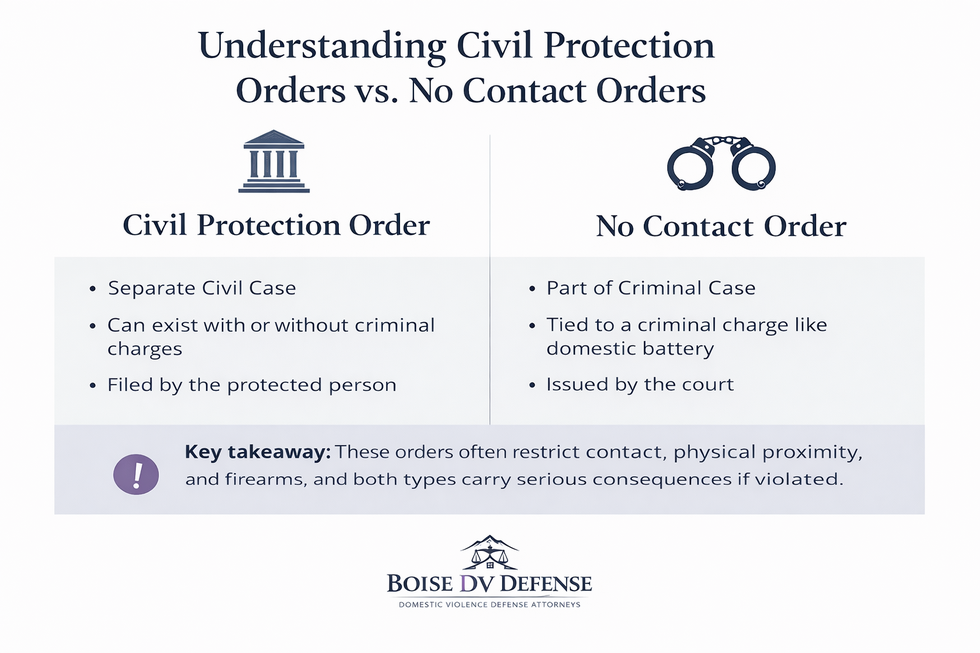
The two orders people confuse most
Criminal no contact orders
A no contact order is typically issued in a criminal case. In Idaho, courts issue and manage these under Idaho Criminal Rule 46.2, including how they are entered, enforced, and how a protected person can request modification or termination.
Key point: even if the protected person wants contact, the order still controls until the court changes it.
Civil protection orders
A civil protection order is a separate civil case. Idaho's domestic violence protection order statutes are in Idaho Code Title 39, Chapter 63, including the hearing process and available relief, and the process for temporary orders.
Key point: a civil protection order can exist with or without a criminal case.
What these orders usually restrict
Exact terms vary, but most orders restrict things like:
-
Direct contact: calls, texts, email, social media messages
-
Indirect contact: messages through friends or family
-
Physical proximity: home, workplace, school, childcare exchanges
-
Firearm possession in certain situations
-
Third party contact used to pressure, intimidate, or bargain
Do not assume “I did not mean harm” matters. If the order says no contact, contact is the violation.
Violations are new crimes and they stack consequences
If you violate a criminal no contact order, Idaho has a specific statute addressing that offense.
Separate from new charges, violations can also trigger:
-
New bond conditions
-
Bond revocation and jail hold
-
Probation violations
-
Evidence the prosecutor uses to argue danger and control
If you are trying to fix the situation, violating the order is the worst way to do it.
Ada County reality: Domestic Violence Court is built for compliance
Ada County runs a dedicated Domestic Violence Court model that coordinates with justice system partners and emphasizes monitoring and compliance. If your case is routed through that system, the court will expect you to follow orders strictly and complete required steps.
How modifications work, at a high level
Courts can modify orders, but you need to do it the right way.
Modifying a criminal no contact order
Idaho Criminal Rule 46.2 lays out a process for modification or termination at the request of the protected person, including a required hearing timeline and notice requirements.
Idaho's official Self Help site also provides guidance and forms for modifying or dismissing a criminal no contact order.
Modifying a civil protection order
Civil protection orders have their own rules and forms, including court self help forms for modification or termination.
Important: “We agree now” is not a modification. The only modification that matters is one signed by the judge and properly entered.
What to do if you have one of these orders
-
Get a copy of the order and read every line.
-
Assume indirect contact counts unless the order clearly allows it.
-
Preserve evidence: screenshots, call logs, messages, and third party communications.
-
Do not ask the protected person to help you fix it by contacting you. That can create new allegations of violation or witness intimidation.
-
Move quickly if you need a lawful modification, especially when parenting schedules, housing, or employment are affected.
Talk to a defense lawyer before you try to negotiate your way around an order
If you were served with an order or accused of violating one, do not freelance your response. We help clients in Boise, Meridian, Garden City, and Eagle navigate these orders without creating new charges.
Call Boise DV Defense at 208-392-1964 or visit us at 10114 W Overland Rd, Boise, ID 83709.