
Immigration Consequences of Domestic Violence Charges in Ada County, Idaho
If you are not a U.S. citizen, a domestic violence arrest or charge in Ada County can create immigration problems that do not show up in state court until it is too late. The biggest trap is this: immigration consequences often turn on the specific statute, the exact elements, the sentence, and the documents created in the criminal case, not just what “really happened.”
This page explains the most common immigration consequences tied to Idaho domestic violence related charges, including domestic battery, attempted strangulation, stalking, and alleged violations of no contact orders.
The hard truth: a plea can be worse than a trial loss
In immigration law, a “conviction” can trigger removal even if the state case seems minor or resolved quickly. A misdemeanor can still cause deportation or block a green card, adjustment of status, naturalization, asylum, or other benefits. Federal law creates a specific deportation ground for crimes of domestic violence and related offenses.
Just as important, defense counsel has a constitutional duty to advise about clear immigration risks before a guilty plea.
The main federal immigration triggers in DV cases
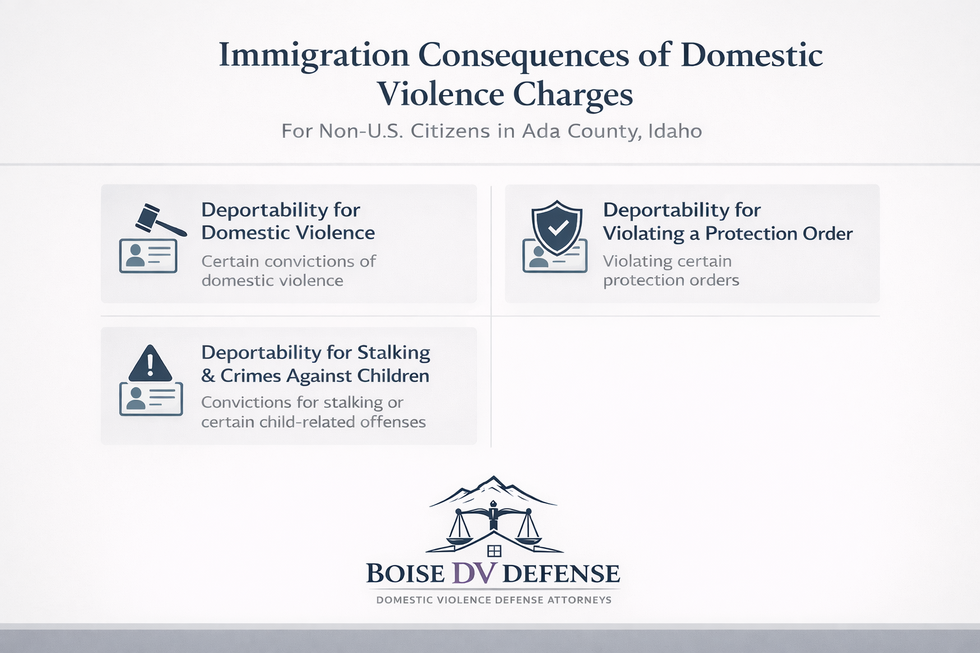
1. Deportability for a crime of domestic violence
Federal law makes a noncitizen deportable if, after admission, they are convicted of a crime of domestic violence.
This ground often turns on whether the offense qualifies as a crime of violence under federal definitions. The key definition is in 18 U.S.C. section 16.
Supreme Court decisions have narrowed parts of that definition in immigration contexts, which is why the exact charge and mental state matter.
Also, immigration courts may use a circumstance specific analysis to decide whether the offense was “domestic” in nature for this ground.
2. Deportability for violating a protection order
Federal law separately makes a noncitizen deportable for violating certain protection order provisions. This can include violations tied to orders meant to prevent violent or threatening acts.
Immigration courts do not always apply the same elements based analysis here that they use for other crime categories, so the order language and the record of what the court found can matter a lot.
In Ada County DV cases, no contact orders are commonly issued and enforced under Idaho law and Idaho Criminal Rule 46.2.
3. Deportability for stalking and certain crimes against children
Federal law also makes a noncitizen deportable for a conviction of stalking and certain child related offenses.
That matters because Idaho stalking charges, including first degree stalking, can show up alongside domestic violence allegations.
4. Inadmissibility and benefit denials, even without deportability
Even if you are not deportable, you can still become inadmissible, which can block a green card, reentry after travel, or many immigration applications. A common basis is a crime involving moral turpitude or controlled substance issues.
How common Idaho DV charges can intersect with immigration law
Domestic battery under Idaho Code section 18-918
Idaho's domestic violence statute, including domestic battery concepts, is commonly charged in Ada County DV cases.
Whether a conviction triggers immigration consequences depends on how the charge aligns with federal definitions and what the record of conviction shows.
Attempted strangulation under Idaho Code section 18-923
Attempted strangulation is a frequent escalation charge in DV cases and can carry substantial immigration risk depending on how the elements and sentence line up with federal categories.
Violation of a no contact order under Idaho Code section 18-920
A no contact order violation can create serious exposure because federal immigration law has a specific deportability ground tied to protection order type conduct, and immigration adjudicators may look closely at what the court found the defendant violated.
Stalking, including first degree stalking under Idaho Code section 18-7905
Stalking is called out explicitly in the federal deportability statute, so these charges demand careful immigration screening before any plea.
Why “dismissed” or “withheld judgment” is not automatically safe
People hear “it will be withheld” or “you can get it reduced later” and assume immigration will not care. That is often wrong. Immigration law has its own definitions and can treat certain outcomes as convictions or as damaging conduct for discretionary decisions. You should assume any plea or admission can be used later unless an immigration competent defense plan is in place.
Practical steps to protect your immigration status
-
Do not accept a plea offer until immigration consequences have been evaluated. This is not optional if you care about status, travel, or future applications.
-
Tell your defense attorney your exact status and history, including prior arrests, prior immigration filings, and any travel plans.
-
Coordinate criminal defense and immigration counsel when consequences are possible. The goal is to structure the criminal outcome to avoid, or at least reduce, immigration triggers.
-
Treat no contact orders and protection order allegations as high risk, even if the underlying DV allegation seems minor.
Frequently asked questions
Can I be deported just for being charged, without a conviction?
A charge alone often does not create deportability, but it can still affect bond decisions, discretionary immigration benefits, and future filings. Also, the wrong statements in court or to law enforcement can create separate issues. The biggest legal triggers typically involve convictions.
If the alleged victim wants the case dropped, does that protect me?
Not necessarily. Prosecutors can continue without victim cooperation, and immigration consequences turn on how the case resolves, not on the relationship status later.
Are no contact order violations really that serious for immigration?
They can be. Federal law includes a deportability ground tied to protection order related conduct, and the analysis can depend on the court's findings and what the order was meant to prevent.
Why does the exact statute matter?
Immigration law often uses element based tests and specific federal definitions, including what counts as a crime of violence.
Talk to a defense attorney before you take any deal
If you are facing a domestic violence related charge in Ada County and you are not a U.S. citizen, you need an immigration informed defense strategy immediately, ideally before the first plea offer is even discussed. We can help. Call us today for a free consultation.