No Contact Orders in Ada County Domestic Violence Cases: A Practical Primer
A criminal no contact order is one of the first and most disruptive court orders in an Ada County domestic violence case. It can affect where you live, who you can talk to, how you parent, and whether you can even retrieve your own belongings.
This page explains what a no contact order is, how it gets put in place, how it gets changed, and why it often stays in place until the Domestic Violence Court removes it, sometimes all the way through the end of probation if the judge orders it.
What a criminal no contact order is
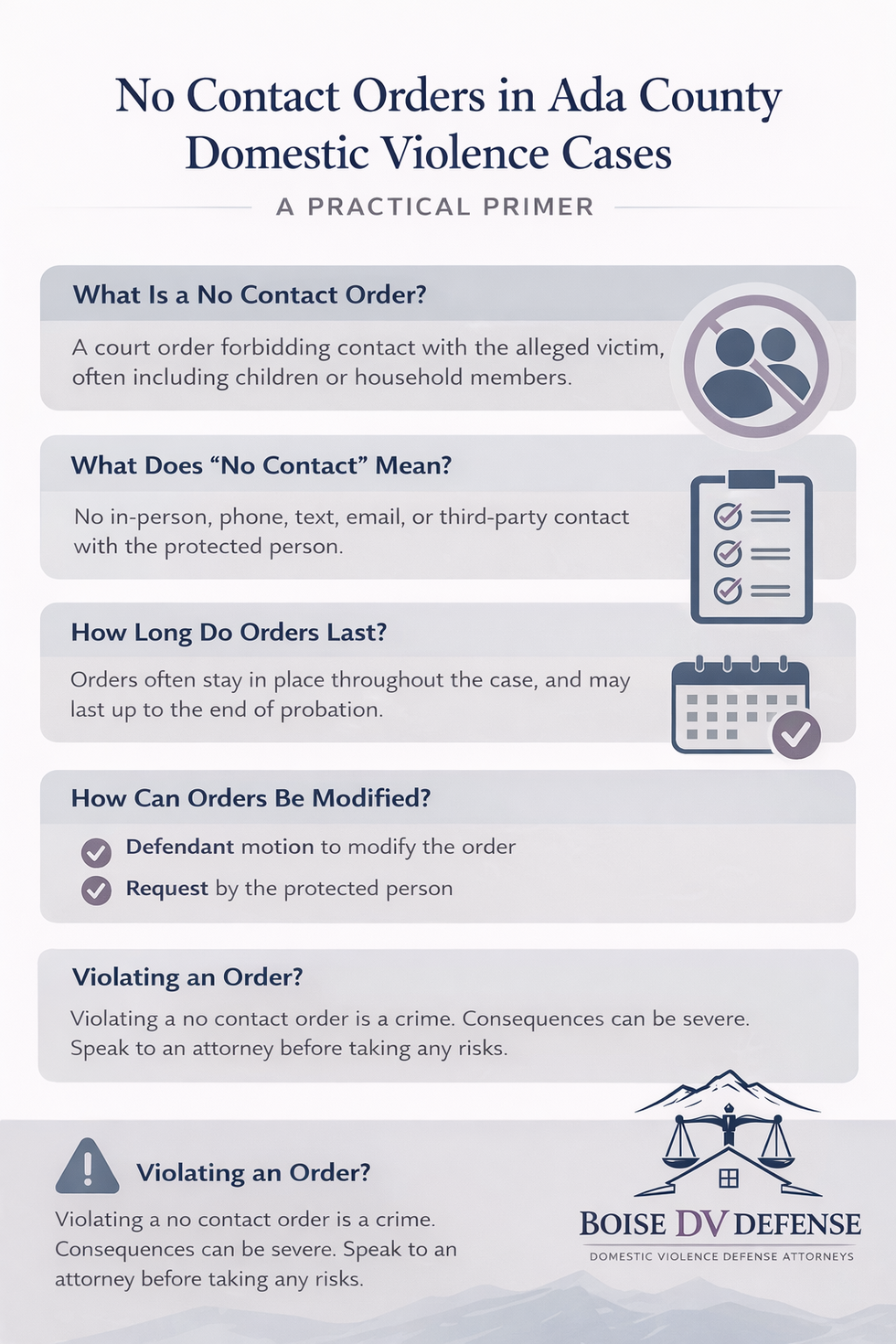
A criminal no contact order is an order in a criminal case that forbids contact with a specific person, typically the complaining witness, and often the children or other household members too. Under Idaho law, courts can issue a no contact order when someone is charged with, or convicted of, certain offenses, including many assault and battery and domestic violence related offenses, and also “any other offense” where the court finds a no contact order is appropriate.
In Ada County domestic violence cases, no contact orders are commonly requested by the prosecutor and set by the judge as part of the initial release and case management process.
How no contact orders go into place in Ada County
In most Ada County domestic violence cases, a no contact order is addressed immediately, often the same day as the initial appearance or arraignment.
Common ways it is imposed:
As a condition of release or bond
Idaho Code allows a no contact order to be imposed as a condition of bond, whether by court order or by Idaho criminal rule.
Practically, that means:
-
You can be released from jail with a no contact condition.
-
The order is enforceable statewide immediately.
As a standalone criminal order under Idaho Criminal Rule 46.2
Idaho Criminal Rule 46.2 requires no contact orders to be in writing on the Supreme Court form, and it sets specific procedures for service and hearings.
The clerk and law enforcement processes matter because the order is intended to be entered quickly into statewide systems, which makes enforcement immediate across counties.
What “no contact” usually means
A no contact order generally prohibits:
-
In person contact
-
Calls, texts, emails, social media messages
-
Third party contact, such as using a friend or family member to pass messages
-
Contact at shared residences, workplaces, schools, or other specified locations, depending on how the order is written
Even “peaceful” contact can still be a violation if the order prohibits it. Consent from the protected person is not a defense to a criminal no contact order. The only safe route is a court modification or termination.
How long no contact orders last
The baseline rule
Idaho law provides that a no contact order remains in effect for the term set by the court or rule, or until terminated by the court.
What happens in real Ada County DV cases
In Ada County domestic violence cases, no contact orders often remain in place until the Domestic Violence Court, or the assigned judge, modifies or dismisses them. That can happen:
-
At the defendant's request through a motion process
-
At the protected person's request through the court's request process
-
As part of a negotiated resolution, such as a plea agreement or sentencing plan
How they can run through the end of probation
Even if the pretrial no contact order is modified, a judge can impose “no contact” as a sentencing term and as a condition of probation. Idaho's probation statute gives the court broad authority to impose probation “under such terms and conditions as it deems necessary and appropriate.”
That is why some defendants experience no contact restrictions that effectively last through the end of probation, especially in domestic violence cases.
How a no contact order is modified or terminated
There are two main pathways, and they are not the same.
1. Defendant driven modification
If the defendant was not present when the order was first issued, Rule 46.2 allows the defendant to request a hearing, but the request must be filed within seven days of service. The court must hold a hearing within fourteen days of the request and provide notice to the protected person and the parties.
Outside that initial short window, modification is typically pursued by filing a motion and setting it for hearing, and the court evaluates safety, case management factors, and the desires of the alleged victim before determining whether to make any modification.
2. Protected person request to modify or terminate
Rule 46.2 expressly allows the protected person to request modification or termination by filing a written, signed request with the clerk in the criminal case. The court must provide for a hearing within fourteen days and give notice to the protected person and the parties.
For victims, Idaho Courts publish forms and instructions for this process, including the “Request to Modify or Dismiss No Contact Order” materials.
What judges usually focus on at a modification hearing
In Ada County domestic violence cases, the court is usually trying to balance:
-
Victim safety and risk management
-
The nature and seriousness of the allegations
-
Whether there were prior incidents or prior orders
-
Whether contact is needed for child exchanges, parenting time, or logistics
-
Whether structured contact could reduce risk, such as limited exceptions for parenting communications
If the case is pending in Ada County Domestic Violence Court, be prepared for the court to tie decisions to treatment evaluations, compliance, and structured accountability. Ada County's Domestic Violence Court was established in 2006 and operates as a specialized model with multiple justice system partners.
Why violations are charged so often, and why they are dangerous
Violating a no contact order is its own crime in Idaho.
A violation is generally punishable by up to one year in jail and up to a 1,000 dollar fine, and it can become a felony with enhanced penalties if there are qualifying prior violations within five years. The statute also limits bond setting for the violation and allows bond consequences in the underlying case.
Bottom line: do not “test” the order, do not rely on verbal permission, and do not assume “accidental” contact will be excused.
A critical technical issue: the order must be valid and properly issued
Idaho appellate courts have addressed problems that occur when no contact restrictions are not issued the right way. In State v. Gorringe, the Idaho Supreme Court addressed no contact provisions that were handled improperly through sentencing paperwork rather than a proper separate order under the rules, and the case highlights why the form and jurisdiction issues matter. State v. Gorringe, 168 Idaho 175 (2021).
This does not mean every case has a technical defect. It means validity is worth checking early, especially when someone is being accused of violating an order.
Practical guidance if you are under a no contact order right now
-
Get a copy of the exact order and read it word for word.
-
Assume third party contact is prohibited unless the order clearly allows it.
-
Do not go to the protected person's home, job, or school to “talk it out.”
-
If children are involved, ask your lawyer about a structured modification request that addresses parenting exchanges safely and clearly.
-
If the protected person wants contact, the correct route is a court request and hearing, not informal contact.
We can help you move it the right direction
At Boise DV Defense, we focus on domestic violence cases in Ada County. If a no contact order is cutting you off from your home, children, or livelihood, the solution is almost never “waiting it out.” It is building a plan to modify it safely, legally, and in a way the court will accept.
Call Boise DV Defense at 208-392-1964 or visit our office at 10114 W Overland Rd, Boise, Idaho 83709.