Ada County Domestic Violence Court in Ada County, Idaho
Domestic violence cases move fast in Ada County, and small early decisions can have big downstream consequences. If you have a domestic violence charge in Ada County, call Boise DV Defense at 208-392-1964 or visit us at 10114 W Overland Rd, Boise, ID 83709 to discuss options with our defense team.
What the Ada County Domestic Violence Court is
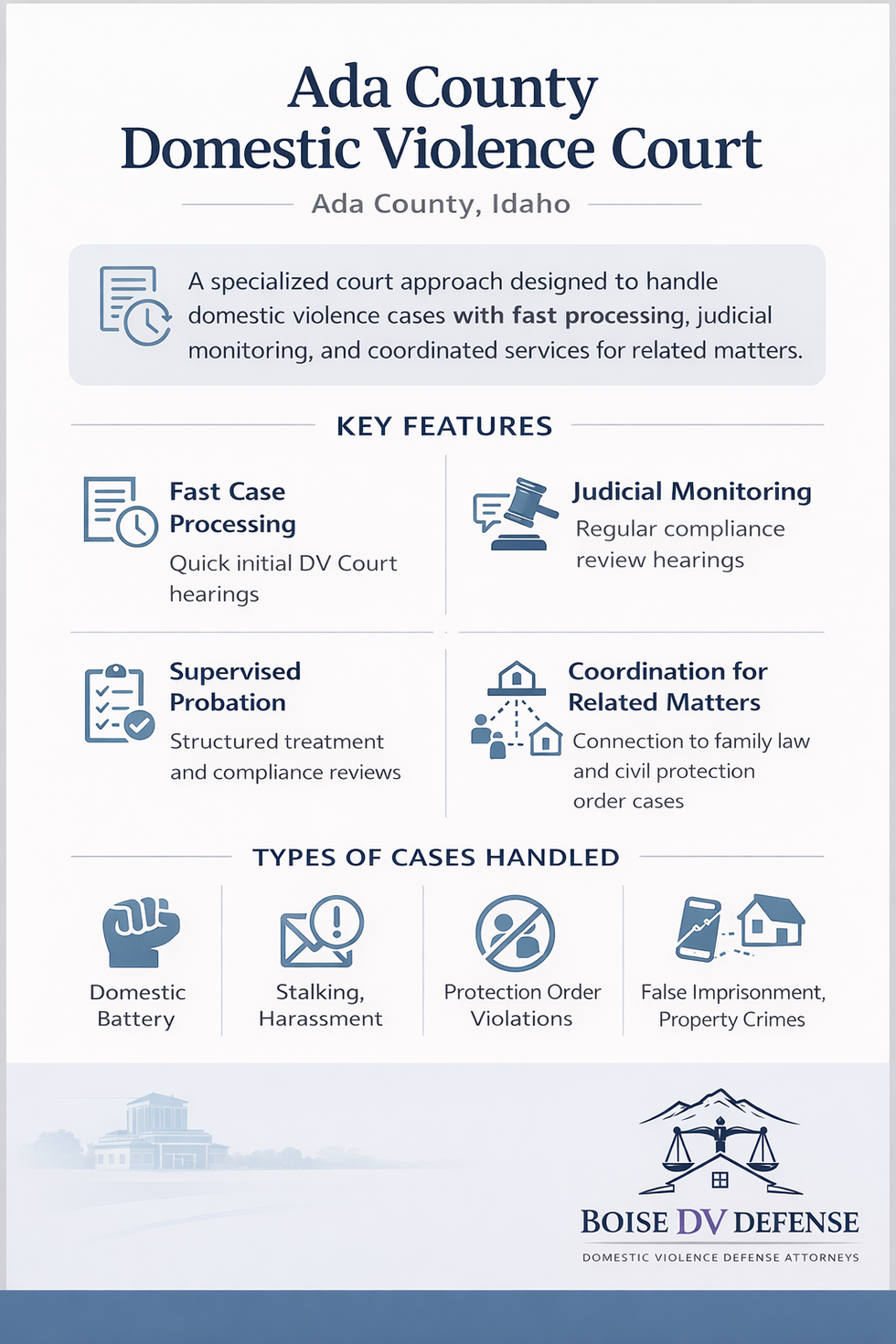
Ada County Domestic Violence Court is a specialized, coordinated court approach designed to handle domestic violence cases with a mix of:
-
Fast-track criminal case processing
-
Enhanced judicial monitoring after sentencing
-
Supervised probation with structured treatment and compliance reviews
-
Coordination with related family law, child protection, and civil protection order matters when appropriate
At the statewide level, Idaho domestic violence courts are intended to improve the civil and criminal system response to domestic violence by enhancing offender accountability and victim safety, while also improving case management and coordination when families are involved in multiple related cases.
In Ada County, the Domestic Violence Court model is commonly described as an accelerated criminal domestic violence court that also includes a permanent civil protective order hearing docket with a separate family law judge.
Why this court exists and what makes it different
Domestic violence cases have unique characteristics that often make “business as usual” criminal court a poor fit, including:
-
Recurring contact between parties due to housing, children, and finances
-
High safety stakes and risk escalation concerns
-
A need for consistent orders across criminal, civil protection order, custody, and divorce cases
-
A need to move offenders into appropriate evaluation and treatment quickly
Idaho's statewide domestic violence court framework is built around those realities and emphasizes consistent handling of domestic violence matters, efficient processing, and coordinated services for victims and children.
In practice, domestic violence court can help as a middle-way between a standard misdemeanor sentence and a felony case. If you are in domestic violence court with a misdemeanor charge, expect sentencing to be much heavier than any other type of criminal charge in the valley. If you are charged with a felony, however, Domestic Violence Court can operate as a way to get your felony charges reduced to a misdemeanor with enhanced probation and rehabilitation based penalties.
History and evolution in Ada County
The early model, Ada County Family Violence Court
Ada County's domestic violence court work traces back to a pilot program launched in July 2002, commonly referred to as the Ada County Family Violence Court. The concept focused on one family, one judge, with early intervention strategies and coordination of multiple related matters within the court system.
In early 2003, the Family Violence Court effort received a multi-year grant connected to strengthening families facing overlapping issues such as domestic violence, substance abuse, and child maltreatment risk, and the evaluation materials describe a collaborative, court-led service coordination approach.
The modern Ada County Domestic Violence Court model
By 2006, Ada County's domestic violence court model is described as being reconstructed to include a fast-track criminal court process and judicial monitoring of domestic violence offenders.
Ada County later gained national recognition through the U.S. Department of Justice Office on Violence Against Women Mentor Court Initiative. In the federal announcement, Ada County's court is described as responding to misdemeanor domestic violence cases since 2006 and using supervised probation, post-sentence judicial monitoring, specialized assessment and treatment, and comprehensive case planning.
Court structure and how it is organized in practice
Ada County's Domestic Violence Court model is best understood as multiple coordinated dockets and roles, not just one courtroom event.
Judges and dockets
Key structural components described in program materials include:
-
Two magistrate judges hearing the domestic violence criminal docket on a rotating schedule.
- At the time this was drafted, the current magistrates are Judge Dean and Judge Fortier.
-
A family law magistrate handling weekly permanent civil protective order hearings. This is currently Judge Stokes.
-
Coordination with child protection matters when parties also have a domestic violence case.
The specialized team
Domestic violence courts are designed to operate with a dedicated set of stakeholders. Idaho's statewide policies specifically call out coordination among judges, prosecutors, defense counsel, victim advocates, trial court administration, family court services, domestic violence court coordinators, community advocates, treatment providers, probation, and law enforcement. The stakeholders meet quarterly to discuss updates and changes. The attorneys from Boise DV Defense regularly attend and participate in these quarterly meetings.
Ada County program materials and mentor court descriptions similarly identify prosecutors, public defenders, probation leadership, dedicated probation officers, victim witness advocates, and a program administrator or coordinator as central to operations.
Screening and case transfer into the Domestic Violence Court docket
The model description explains that the Boise City Attorney office and the Ada County Prosecutor office identify, screen, and transfer cases into the Domestic Violence Court.
Practically, that means entry into the DV Court docket is not purely automatic. Screening decisions often turn on charging statutes, relationship type, criminal history, risk indicators, and case posture.
What types of cases and defendants qualify
Domestic Violence Court written criteria, criminal case types
Ada County's published criteria list includes a wide range of charges that can be domestic violence related when the parties qualify as intimate partners. The criteria list includes:
-
Assault, battery, sexual battery
-
False imprisonment, malicious injury to property
-
Disturbing the peace, intentional interference with a telecommunication line
-
Unlawful entry
Relationship requirements, who qualifies as an intimate partner
Program criteria describe intimate partner relationships to include household members and people in a dating relationship, as defined by Idaho law. The criteria explain household member concepts such as spouses, former spouses, people with a child in common, and people who cohabit. The criteria also summarize that a dating relationship is a romantic social relationship and lists factors courts may consider such as nature of the relationship, length, frequency of interaction, and time since termination.
Misdemeanor cases, and some felony cases reduced to misdemeanors
Ada County's mentor court fact sheet and court model materials explain that the Domestic Violence Court hears misdemeanor domestic violence cases and also handles felony plea matters that are reduced to misdemeanor domestic violence offenses.
The Ada County DV Court participant handbook also describes that a felony domestic violence case may enter the DV Court docket through a plea agreement that reduces the case to a misdemeanor domestic violence charge when approved and accepted by the court.
How a typical Ada County DV Court criminal case moves through the system
This section is a practical map of what many defendants experience, using the Ada County DV Court participant handbook as the closest “what to expect” guide for the misdemeanor DV Court process.
Step 1: Arrest, arraignment, bond, and a no contact order
After an arrest, the arraignment judge sets bond and conditions of release. In most cases, those conditions include a no contact order protecting the alleged victim.
The handbook explains that the no contact order can be addressed again at the next DV Court appearance, and that the court considers multiple factors when deciding whether to modify or terminate it, including history of violence, criminal record, circumstances of the current incident, the victim's participation in safety planning and empowerment programming, and the assessed risk level for future violence.
Step 2: Early DV Court setting and pretrial
The initial DV Court appearance is typically set within a week after arraignment, and the next appearance after arraignment is commonly a pretrial conference.
A central feature of the program is speed. Ada County model materials describe cases being set for pretrial conference one week after arraignment and being typically disposed within about 60 days from arrest. In practice, that is only for cases that resolve with a guilty plea. Setting the case for trial extends this timeline, and even if the case pleads within 60 days, expect review hearings for at least a year following sentencing.
The participant handbook states the goal is to resolve cases by plea or jury trial within about six weeks of the initial DV Court appearance.
Step 3: Plea, trial, or negotiated resolution
Domestic violence courts are not simply treatment courts. They are still criminal courts, and defendants retain constitutional rights. While trials happen frequently in domestic violence cases, those are handled as standard misdemeanor trials. What is different is the court's focus on plea and sentencing including:
-
early resolution
-
early assessment and planning
-
and structured monitoring after plea and sentencing
Step 4: Sentencing and the start of the monitored probation phase
The participant handbook describes several common sentencing features in the DV Court program:
-
Credit for time served prior to sentencing, and usually no additional jail imposed at sentencing
-
The Court may impose discretionary jail that can be used later as an intermediate sanctions
-
Fines are not required in most cases, but defendants must pay treatment costs, court costs, and supervision fees. These fees are generally assessed monthly rather than in one lump sum
-
Many participants are ordered to two years of supervised probation, with the possibility of requesting unsupervised probation after completing requirements.
Court supervision, review hearings, and what the judge is monitoring
Judicially monitored compliance reviews
A defining feature of Ada County DV Court is the schedule of review hearings where the judge receives updates and holds the defendant accountable.
The participant handbook explains:
-
The judge receives progress reports prepared by probation
-
The judge may ask questions about compliance, progress, and challenges
-
Doing well can lead to fewer review hearings
-
Doing poorly can lead to more frequent hearings, additional treatment requirements, or discretionary jail
-
Failure to appear can result in a bench warrant
Ada County model materials describe judicial review hearings set roughly every 14 to 120 days. In standard practice, this is usually up to your probation officer to tell the Court how often they would like you back in Court for reviews.
The probation officer's role
Probation officers are central. The mentor court model describes dedicated probation officers who monitor compliance, conduct assessments, connect defendants to appropriate treatment, enforce court orders, and explain obligations.
The participant handbook also describes a Level of Service Inventory assessment completed at the first probation meeting, used to develop a case plan and inform supervision and treatment decisions. This is an assessment to see what you may need extra help with in managing your probation and recovery.
Probation fees, supervision rules, and the consequences of noncompliance
Fees
The participant handbook lists misdemeanor probation department fees currently set at 75 dollars per month, sometimes on a sliding scale, and states fees must be paid before final disposition unless the court orders otherwise.
Immediate sign up
Defendants that are sentenced to supervised probation must contact Ada County Misdemeanor Probation within 24 hours of sentencing to sign up for probation. While there is a probation office at the Ada County Courthouse, it is generally not staffed. Make sure to follow up with probation immediately following sentencing at the address give to you by the Court.
Common probation conditions
The supervised probation order included in the handbook contains common conditions, including:
-
No use or possession of alcohol, controlled substances, or intoxicants unless lawfully prescribed
-
Testing as directed
-
Completion of ordered assessments and treatment
-
Required review hearings
-
Travel restrictions without a permit
-
Payment of supervision costs and other fees
What happens if you violate
Failure to follow probation terms or DV Court orders can result in program dismissal, a probation violation, revocation of a withheld judgment, imposition of a judgment of conviction, resentencing up to the maximum allowed for the conviction offense, or additional imposed jail time and fines. The court may also use discretionary jail as an intermediate sanction in some circumstances.
Evaluation and treatment requirements
The 52-week domestic violence intervention norm
The Ada County Domestic Violence court standard treatment requirement is a 52-week program, which must be completed within 15 months, and DV Court approval is required for deviations from that norm. Sometimes, a domestic violence evaluation can recommend treatment for alcohol or substance abuse counseling or anger management outside of the standard 52-weeks, but that is infrequent.
Domestic violence evaluations
In most cases, the court orders a domestic battery evaluation to assess risk and recommend a tailored treatment plan, though the handbook notes the evaluation requirement may be waived when the court orders a participant directly into treatment. Sometimes, we recommend you simply starting the full 52-week class to avoid the extra expense of the evaluation.
Idaho's statewide framework for domestic violence evaluations is anchored in Idaho Criminal Rule 33.3 and Idaho Court Administrative Rule 75:
- Rule 33.3 is used to order an evaluation for people who plead guilty or are found guilty of domestic assault, domestic battery, or attempted strangulation, and requires the evaluation report to include detailed identifying information, a risk assessment, behavioral and physical health sections, and other specified content. It also requires the use of approved screening or assessment tools in key areas.
- Rule 75 establishes who is an approved evaluator, including licensure requirements, specialized domestic violence training requirements, experience requirements, background check requirements, and continuing education obligations.
- Idaho's evaluator roster guidance explains that evaluator reports generally include risk assessments, any substance abuse concerns, any mental health issues, and recommendations to the judge.
Treatment providers and the Ada County approved provider list
Ada County maintains an approved treatment provider list used as a resource for defendants. The list itself warns:
-
Courts do not vouch for or endorse any provider not accept evaluations or treatment from a provider not on the list
-
A judge may require a conflict waiver if the same provider who conducted the evaluation also provides treatment
-
Costs vary by provider
Because treatment selection can impact outcomes, we strongly recommend defendants coordinate provider choices with defense counsel before spending money or starting a program.
No contact orders, civil protection orders, and the Healthy Families approach
Criminal no contact orders
In Ada County DV Court, no contact orders are commonly issued early and can later be modified in appropriate circumstances. The participant handbook outlines factors the court may consider when evaluating modification or termination, with an emphasis on safety and risk assessment.
Idaho's statewide domestic violence court policies also anticipate that domestic violence courts may handle criminal no contact order modification or termination motions and no contact order violation matters as part of their assigned case types.
Civil protection orders and the Healthy Families model
Ada County's domestic violence court materials describe a civil protection order approach sometimes called the Domestic Violence Civil Protection Order Program:
-
Criteria described include civil protection order cases involving cohabiting intimate partners or dating relationships where children are involved
-
The model is described as one judge, one family, where a family court judge presides over the civil protection order and the related divorce or custody case
-
The judge may order counseling, evaluations, parenting classes, anger management, or domestic violence intervention
-
Review hearings are used to monitor compliance
-
Incentives can include modifications to the protection order, such as allowing supervised visitation
Common pitfalls we see for defendants in Ada County DV Court
These issues come up repeatedly in real cases, and many are addressed directly in the participant handbook and provider list.
-
Missing a hearing
Missing DV Court appearances can lead to bond forfeiture and arrest warrants. -
Assuming your lawyer can appear without you
The participant handbook emphasizes personal attendance unless the court specifically excuses it. -
Failing to sign up for probation immediately after sentencing
The handbook warns you must contact misdemeanor probation within 24 hours. -
Starting treatment with an unapproved provider
The provider list warns judges may not accept evaluations or treatment outside the list, and you should check with counsel. -
Alcohol and drug use while on supervision
The handbook and probation order language treat abstinence and testing compliance as a core requirement. -
Contact with the protected party contrary to orders
Even “mutual” contact can create new criminal exposure and can be used as a compliance issue at review hearings.
Collateral consequences that often matter in domestic violence cases
Firearms restrictions under federal law
Domestic violence cases can trigger federal firearm restrictions that are separate from what Idaho state court orders say.
Two common federal categories are:
-
Firearm restrictions tied to certain protective orders under 18 U.S.C. section 922, subsection g, paragraph 8
-
Firearm restrictions tied to misdemeanor crimes of domestic violence under 18 U.S.C. section 922, subsection g, paragraph 9
The U.S. Supreme Court upheld the federal firearm prohibition for people subject to certain domestic violence restraining orders in United States v Rahimi.
Firearm consequences are fact-specific and can be life-changing for hunters, armed security, military members, and many others. Do not assume a withheld judgment or later dismissal fixes federal firearm issues.
Record consequences and withheld judgments
Successful completion of probation may entitle a participant to dismissal under a withheld judgment unless a judgment of conviction was imposed. In Idaho, withheld judgment and dismissal concepts are governed by Idaho Code section 19-2604.
How a defense attorney helps in Ada County Domestic Violence Court
At Boise DV Defense, our job is not just to show up. It is to build a plan that protects your rights while positioning you for the best achievable outcome in a system designed to move quickly and monitor closely.
Defense counsel can help with:
-
Early case assessment, including whether the state can prove the relationship element and the underlying conduct
-
Negotiation strategy with the Boise City prosecutor or Ada County prosecutor, depending on the case
-
Challenging bond conditions and litigating no contact order modifications when legally appropriate
-
Advising on evaluator and treatment provider selection to avoid spending money on a program the court may not accept
-
Sentencing advocacy, including structured alternatives that reduce long-term damage
-
Compliance planning to reduce the risk of avoidable probation violations
-
Record relief planning where eligible
To speak with Boise DV Defense, call 208-392-1964.