
Attempted Strangulation Charges in Idaho (I.C. § 18-923)
If police or prosecutors accuse you of “attempted strangulation” in Boise or anywhere in the Treasure Valley, treat it as a high-stakes felony from day one. Idaho's statute is written to make these cases easier to charge and harder to “explain away,” even when there are no visible injuries.
Boise DV Defense defends attempted strangulation allegations in Ada County and throughout Southwest Idaho. Call 208-392-1964 to speak with a defense attorney.
What Idaho Means by “Attempted Strangulation”
Idaho Code § 18-923 makes it a felony to “willfully and unlawfully choke or attempt to strangle” either:
-
a household member, or
-
a person with whom you have or had a dating relationship.
“Household member”
For § 18-923, “household member” uses the definition in Idaho Code § 18-918(1)(a): spouse/former spouse, a person you share a child with, or a person you are living with while dating.
“Dating relationship”
A “dating relationship” is defined as a social relationship of a romantic nature, and the court may consider factors like the nature of the relationship, how long it existed, frequency of interaction, and how long since it ended.
Key Parts of the Law That Surprise People
No injury is required
The statute is explicit: you do not need to cause injuries for the State to try to prove attempted strangulation.
The State does not have to prove intent to kill or injure
Prosecutors do not have to prove you intended to kill or injure someone. The only intent required is the intent to choke or attempt to strangle.
This is one reason these cases often come down to credibility disputes, medical evidence - or lack of it - and context.
Possible Punishments for Attempted Strangulation in Idaho
Standard felony penalty
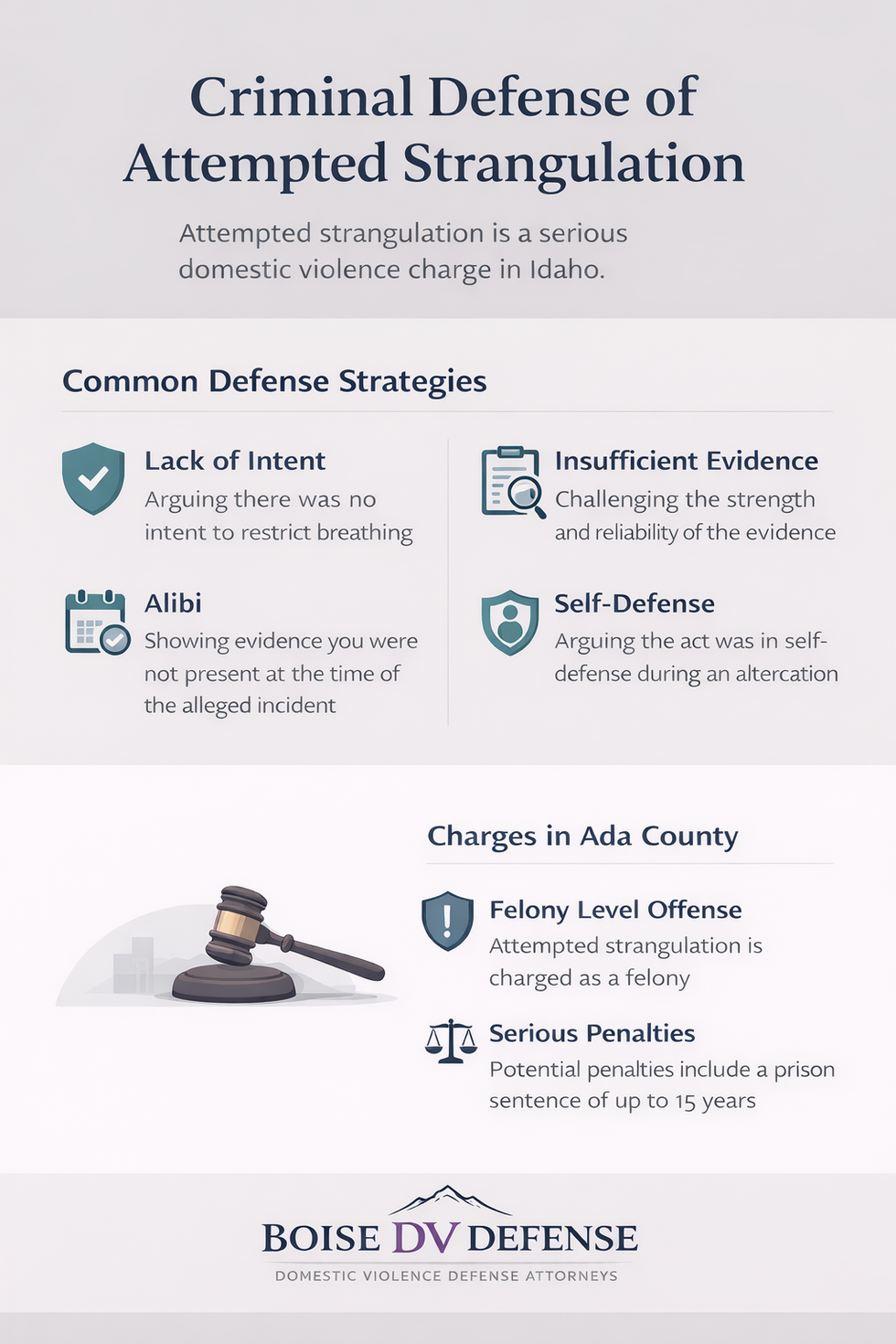
Attempted strangulation is a felony punishable by up to 15 years in Idaho state prison.
Enhanced penalty for prior qualifying convictions
If, within 15 years, you have a prior qualifying conviction - including a prior § 18-923 violation or qualifying felony domestic-violence conviction - the new attempted strangulation conviction can be punished by up to 20 years in prison and/or up to a $10,000 fine.
“In the presence of a child” doubles maximum penalties
If the act occurred “in the presence of a child” under 16, the statute says the maximum penalties shall be doubled. The child need not actually see or hear the fight, but need only be in a place where they could have seen or heard what happened. This means that if there is a child in the house when police respond, this enhancement is often added to the case.
Practically, this can dramatically increase exposure and settlement pressure.
Mandatory Evaluation, Counseling, and Treatment Issues
A guilty plea or conviction under § 18-923 triggers the domestic-violence evaluation and treatment framework referenced in § 18-918(7).
Important details defendants often miss:
-
The evaluation is generally at the defendant's expense.
-
The evaluation is supposed to be completed before sentencing when possible.
-
If the evaluation is not provided to the court, the court may proceed—and counseling is presumed required unless the defendant proves otherwise by a preponderance of evidence. The standard treatment in these cases is 52 weeks of domestic violence counseling.
-
Failure to make a good-faith effort to provide the evaluation may be treated as an aggravating circumstance at sentencing.
Other Consequences Beyond Jail or Prison
Even when a case resolves without the “maximum,” attempted strangulation allegations commonly create serious collateral damage:
-
No-contact orders - often immediate and strictly enforced.
-
Firearm consequences - a felony conviction commonly triggers long-term restrictions under federal law; separate court conditions may also restrict possession while the case is pending.
-
Employment and professional licensing issues - background checks, suspensions, mandatory reporting.
-
Immigration consequences for non-citizens - potentially severe; you need counsel experienced in criminal-immigration intersections.
-
Family law and custody fallout, including supervised visitation concerns and leverage in parallel disputes.
How These Cases Are Commonly Charged in Ada County
Attempted strangulation is frequently charged alongside:
-
domestic battery / domestic assault,
-
violating a no-contact order, or
-
witness intimidation allegations.
Prosecutors take these allegations seriously because strangulation is viewed as a high-risk indicator. That means the case strategy has to be organized early—especially around statements, medical records, phone data, and third-party witnesses.
Defense Themes That Often Matter
Every case is fact-specific, but defenses frequently focus on:
-
Identity / credibility problems: what was actually said, when, and to whom.
-
Lack of the required intent: accident, defensive movement, reflexive contact, or misinterpretation of what happened.
-
Alternative explanations for marks or symptoms: pre-existing conditions, unrelated injuries, consensual contact mischaracterized, or later-occurring causes.
-
Evidence quality: body cam, timing of photos, medical documentation, inconsistencies across reports.
-
Relationship definition disputes: whether the complainant fits the statutory relationship category.
What You Should Do Immediately If You're Investigated or Charged
-
Do not “talk it out” with the complainant—that can create new charges especially no-contact violations or witness intimidation charges.
-
Do not give a detailed statement to police without counsel.
-
Preserve evidence: texts, call logs, photos, location data, and names of witnesses.
-
Get counsel early—these cases can pivot on the first 72 hours of evidence collection.
Talk to a Boise Attempted Strangulation Defense Attorney
If you're facing an attempted strangulation charge under Idaho Code § 18-923, the risk is real: felony exposure, long prison maximums, and consequences that can follow you for years.
Call Boise DV Defense at 208-392-1964 to speak with a defense attorney about next steps.